

Crew Resource Management (CRM) Ground School
Crew Resource Management (CRM) Ground School
The complete Canadian CRM course — all ten core elements of Transport Canada AC 700-042, taught on camera by an active Airbus A321 Captain and airline CRM course developer. 9+ hours of instruction, a full TSB case-study video library, and the references you’ll keep for the rest of your career.
Enrol Now — $119 $149
Limited-time sale price · Self-paced · 6 months of access · Certificate of completion
Watch the course preview.
The skills that keep crews out of accident reports
Most aviation accidents don’t start with a mechanical failure — they start with a missed call, an unchallenged decision, a crew behind the aircraft. Crew Resource Management is the discipline of catching those errors before they matter, and it’s required training for crew members at Canadian commercial operators under AC 700-042.
This course teaches it the way it’s taught at the airline level: threat and error management as the backbone, every human-factors element built on top of it, and real Canadian TSB investigations showing where the defences failed — and where good crews made them hold.
- Built element-by-element against AC 700-042 Issue 02 — nothing skipped, including resilience, surprise and startle, and safety culture
- Canadian content throughout: CARs, TSB reports, Canadian terminology and phraseology
- Covers single-pilot resource management (SRM) — this isn’t a two-crew-only course
- Quizzes at every topic and lesson, a final course quiz, and a certificate for your training file
Walk into your interview already speaking the language
Canadian commercial pilot training is almost entirely single-pilot — then your first airline or operator interview asks you scenario questions built on CRM concepts, and new-hire ground school assumes you already know the vocabulary. Most 250-hour applicants don’t. That gap is your opportunity.
- Interview preparation — behavioural and scenario questions at airlines and 703/704 operators draw directly on TEM, communication, and decision-making concepts taught in this course
- A resume line few applicants have: initial CRM training completed to the AC 700-042 standard, with a certificate to show for it
- The single-pilot-to-multi-crew transition, taught by an A321 Captain who sits on the other side of that flight deck — and knows what airlines expect from a new first officer
- Arrive at new-hire ground school ahead — CRM vocabulary, TEM framing, and monitoring discipline already in place while your classmates hear it for the first time
Already flying the line? The course meets you there too — it’s built to the same standard your operator’s training program is measured against.
What’s in the course
Eleven lessons, in a deliberate order — each element builds on the last, and everything comes together in threat and error management at the end. Every lesson has video instruction, downloadable references, and a quiz.
1. The History of CRM · video + quiz
Where CRM comes from and why it exists: the accidents that forced the industry to admit that competent pilots crash serviceable airplanes, and how CRM evolved from “charm school” into the safety discipline it is today.
2. Effective Communication · video + quiz
Closed-loop communication, briefings that actually transfer information, assertion when it matters most, and the PACE model for escalating a concern — from probing question to taking control.
3. Situational Awareness · video + quiz
The three levels of SA — perceiving, understanding, projecting — how SA really breaks down in flight, the traps that erode it, and how crews rebuild the picture when it’s slipping.
4. Pressure & Stress · video + quiz
What stress does to perception, memory, and decision making; the difference between pressure that sharpens and stress that narrows; and recognizing it in yourself and your crew before it flies the airplane.
5. Fatigue · video + quiz
The science of sleep and circadian rhythm, why fatigue impairs like alcohol but hides better, and the countermeasures that work — personally and operationally.
6. Workload Management · video + quiz
Prioritizing, delegating, and sequencing tasks to stay ahead of the aircraft; recognizing overload and underload; and the techniques crews use to manage the busiest phases of flight.
7. Aeronautical Decision Making · video + quiz
Structured decision making under real constraints — models that work under time pressure, the biases that bend your judgment, and why the go/no-go decision is rarely the hard one.
8. Leadership & Followership · video + quiz
What effective command actually looks like, why followership is a skill and not a rank, authority gradients that are too steep or too flat, and the modern observable behaviours used to assess crews.
9. Automation & Monitoring · video + quiz
Mode awareness, automation surprises, staying in the loop when the aircraft is doing the flying, and the monitoring discipline that separates a crew from two passengers in the front seats.
10. Resilience Training · video + quiz
The surprise and startle effect, what your body does in the first seconds of the unexpected, and the trained responses that get a crew from startled back to flying — the Appendix C content most courses never touch.
11. Threat & Error Management · video + quiz + case studies
The framework everything else feeds into: identifying threats, trapping errors, recovering undesired aircraft states — avoid, trap, mitigate. Includes full TSB case study analysis through the TEM lens, covering both accidents and well-managed occurrences.
Plus a course introduction lesson, a TSB case-study video library, downloadable observable-behaviour worksheets and reference booklets in every topic, and a final course quiz before your certificate is issued.
Learn CRM from someone who teaches it at the airline level
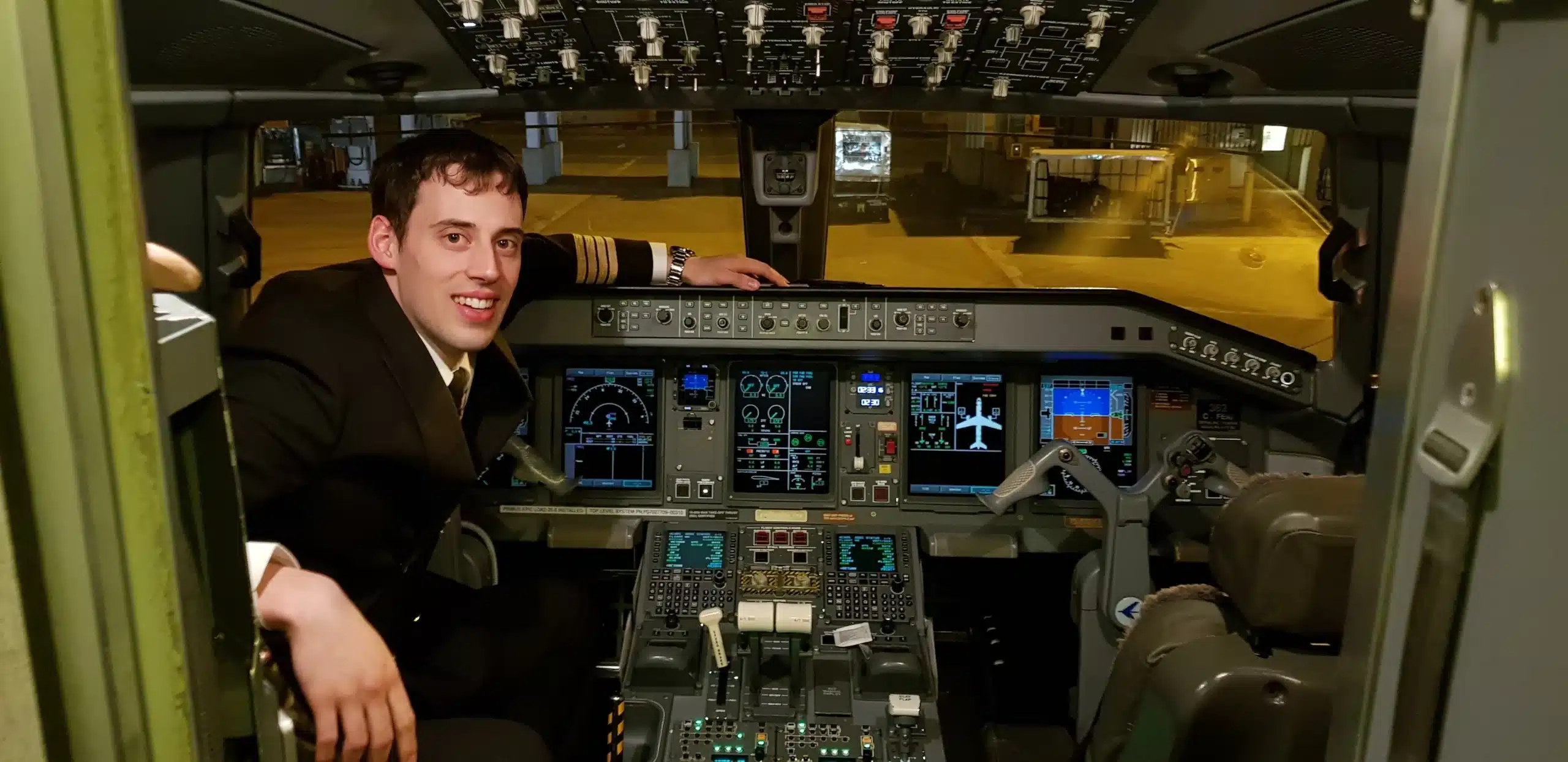
Daniel Gustin is an active Airbus A321 Captain flying the line today, a CRM course developer at the airline level, and a Transport Canada Class 1 flight instructor with a Master of Education. He has developed and delivered CRM training built to EASA European standards — the most demanding CRM framework in the world — and this course brings that airline-grade material to Canadian pilots and operators.
- Active airline Captain — current multi-crew experience on the Airbus A321
- CRM course developer at an airline — this is his professional specialty
- Trained crews to EASA European standards
- Transport Canada Class 1 flight instructor · Master of Education
On Sale
One-time payment · 6 months of access
- 9+ hours of on-camera video instruction
- Full TSB case-study video library included
- All ten AC 700-042 core elements in depth
- Downloadable reference library — yours to keep
- Topic, lesson, and course quizzes
- Certificate of completion for your training records
Training managers and operators
This course covers the initial CRM training content standard in AC 700-042 Issue 02 — all ten core elements plus the Appendix C and D subject areas — and is designed to slot into a CARs 702/703/704 operator’s approved training program as the individual knowledge component, with completion records to support your training file. Because it’s fully self-paced online, there’s no classroom day to schedule, no travel, and no crew pairing to disrupt — pilots complete it in downtime. For multiple seats, a condensed operator edition, or an element-by-element coverage mapping for your program documentation, contact us.
