


Douglas Protractor
$6.90
The square plotter Canadian students use for cross country planning, and the one you will want in the exam room. Five inch Lexan square with a 2 NM grid, custom made for us by Hammond Aviation.
- Durable Lexan, will not melt, warp or break in extreme temperatures
- 2 NM grid lines up cleanly with the parallels on a VNC
- Reads true track straight off the chart
- Guaranteed for life
- Included in the Ground School Kit
Low cost flat rate shipping anywhere in Canada.
Description
The Douglas Navigational Protractor
A six dollar piece of plastic that every Canadian student pilot ends up owning. The Douglas protractor is how you read a true track off a chart: lay it on your course line, line the grid up with a meridian, and read the number. It is faster than it sounds once you have done it twice, and it is the skill the navigation section of the written exam is built on.
Ours is custom made by Hammond Aviation in Lexan rather than acrylic, which is why it survives a flight bag. It will not melt on a hot ramp, warp in a cold hangar, or snap when something heavy lands on top of it. It is guaranteed for life, which for a tool at this price is less a warranty than a statement about how long it lasts.
You need one for the written exam
This is the part students miss. Navigation questions on the Transport Canada written exam are worked off a printed chart excerpt, with a plotter and a flight computer on the desk in front of you. You cannot open an electronic flight bag app in the exam room.
So whatever you plan on using in the aeroplane, you will be reading tracks off paper with one of these at least once, under time pressure, on a day that matters. It is worth owning one early and getting fluent with it rather than meeting it the week before you sit the exam.
How to use a Douglas protractor
Four steps, and the whole thing takes about fifteen seconds once it is familiar.
- Draw your track. Rule the line between your departure and destination on the chart.
- Centre the protractor on the track. Put the centre point of the protractor anywhere on your course line, ideally where it crosses a meridian.
- Square it to north. Rotate until the grid lines on the protractor are parallel with a line of longitude, with north on the protractor pointing to true north on the chart.
- Read the true track. Read the number where your course line leaves the protractor. That is your true track, and you still need to apply magnetic variation from the chart to turn it into a magnetic heading.
Our Private Pilot Ground School works through this on screen in the navigation section, including the part students actually get wrong, which is forgetting variation and arriving somewhere unexpected.
Paper and glass both
Most pilots fly with an app now, and nobody is pretending otherwise. The protractor is not competing with ForeFlight for what you use on a cross country. It covers the two situations the app does not: the exam room, where electronics are not permitted, and the day the tablet overheats on the glareshield or the battery is flatter than you thought.
That is also how Transport Canada still frames the skill. The planning the exam tests is manual planning, and it stays on the syllabus for the same reason the E6-B does: understanding how the numbers are produced is what lets you notice when the app gives you a wrong one.
What to buy it with
- An E6-B flight computer, the other half of manual flight planning
- A kneeboard to work on in the aeroplane
- From the Ground Up, where the navigation theory behind all of this is explained
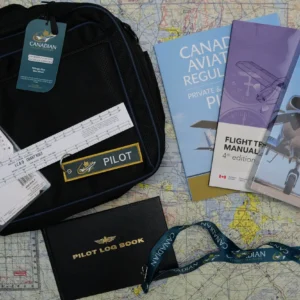
- Or the Ground School Kit, which includes this protractor along with the books, flight computer, logbook and bag
Questions about the Douglas protractor
Can I use it in the Transport Canada written exam?
Yes, and you will want to. Navigation questions are worked from a printed chart excerpt, and a plotter and manual flight computer are the tools you are expected to bring. Transport Canada sets out what the exam covers in TP 12880. Electronic flight planning apps are not permitted in the exam room.
What is the difference between a Douglas protractor and a plotter?
A Douglas protractor is a square grid you lay flat on the chart and rotate to north, which makes it quick and hard to misread. A conventional plotter is a ruler with a protractor built into one edge, which also measures distance but is fiddlier to align. Canadian training has long favoured the Douglas square, which is why it is the one in our kit.
Does it measure distance as well?
Not directly. The 2 NM grid gives you a sense of scale and is useful for offsets, but for distance along a track most pilots use the scale printed on the chart itself or a ruler. The protractor’s job is the angle.
Does it give true or magnetic track?
True. You align it with the meridians, which are true north, so what you read off is true track. Apply the magnetic variation shown on the chart for that area to get a magnetic heading, then correct for wind. That sequence is one of the most commonly examined things on the written.
Is it really guaranteed for life?
Yes. Lexan is the reason it is a credible promise rather than marketing. It is the same family of plastic used for safety glazing, and it resists heat, cold and impact far better than the acrylic plotters that crack in a flight bag.
Do I need one if I already have the Ground School Kit?
No, one is already in it. Buy a loose one if you want a spare, if you lost yours, or if you are kitting out a second pilot. At this price most instructors keep one in every bag.
Only logged in customers who have purchased this product may leave a review.
Related products
-
Sale!

Ground School Kit
Price range: $254.00 through $295.00Select options This product has multiple variants. The options may be chosen on the product page -

-
VFR Navigation Chart – VNC
$16.95Select options This product has multiple variants. The options may be chosen on the product page -



Reviews
There are no reviews yet.