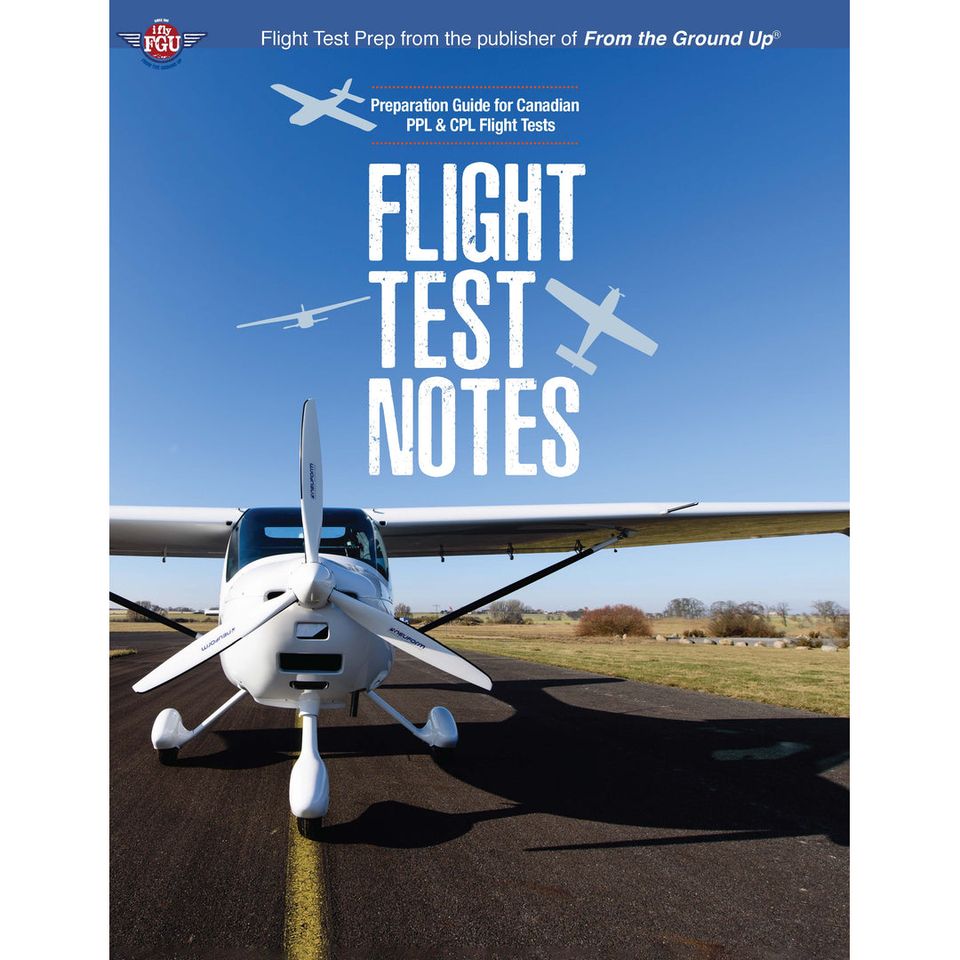
Flight Test Notes – 4th Edition
$49.95
A sequence by sequence guide to what the examiner will ask you to fly, from the ground briefing to the last landing. Written by an ATPL holder and certified instructor, for the Canadian PPL and CPL flight test.
- Covers the ground briefing and every air exercise in the test
- Laid out for quick reference, not cover to cover reading
- Supplements the Transport Canada flight test guides, TP 13723 and TP 13462
- 4th edition, ISBN 978-1-990849-00-8
- Used at the end of our PPL and CPL training
Low cost flat rate shipping anywhere in Canada.
44 in stock (can be backordered)
Description
Flight Test Notes, 4th Edition
The written exam is the part students worry about. The flight test is the part that catches them out. You can know the theory cold and still lose marks because you did not know the examiner would ask for a diversion at that point, or because your pre-flight briefing wandered, or because you had never thought about what “within 100 feet” actually looks like on the altimeter when you are busy.
Flight Test Notes is the book that closes that gap. It walks the test in the order it happens, from the ground briefing through to the final landing, and tells you what each sequence is for and what the examiner is watching. It was written by an ATPL holder and certified instructor, which is to say by somebody who has sat in the right seat watching candidates make the same avoidable mistakes.
What it walks you through
Every sequence the examiner can call for, in the order you are likely to meet it.
Why it works better than the Transport Canada guide alone
The flight test guides, TP 13723 for the private licence and TP 13462 for the commercial, are the official standard. Read them. They tell you the tolerances and the marking scale, and your examiner works from them.
What they do not do is tell you how to fly the test. They are written as a marking standard, not as preparation. This book sits alongside them and fills in the part the guide leaves out: what the sequence is actually testing, where candidates lose marks, and how to structure your own practice so that your last few dual hours before the test are spent well.
When to buy it
Later than most people expect. There is no benefit to reading this at hour ten. It earns its place in the last stretch of training, once you are flying the exercises competently and the conversation with your instructor has turned to booking the test.
That is where it fits in our own training: students work through Private Pilot Ground School and the written exam first, then pick this up while they are polishing the flying. If you are on the commercial path, the same applies at the end of Commercial Pilot Ground School, and the book covers both tests.
What to read it with
- The Flight Training Manual, which covers how each exercise is flown and taught. This book covers how it is tested.
- From the Ground Up, for the theory the examiner can question you on during the ground briefing.
- A kneeboard and your logbook, both of which you will have in the aeroplane on the day.
- The rest of our pilot shop for charts, supplies and books.
Questions about Flight Test Notes
Is this for the PPL or the CPL flight test?
Both. It supplements TP 13723 for the private licence and TP 13462 for the commercial, and covers the sequences common to each. If you are going on to a commercial licence, the book carries over rather than being replaced.
Do I still need the Transport Canada flight test guide?
Yes. The TP guide is the marking standard your examiner works from, and you should read the one for your licence. This book is preparation, not a substitute for the standard. Use them together.
When in my training should I buy it?
Toward the end, once you are flying the exercises reasonably and the flight test is in sight. Reading it early does not hurt, but it does not help much either. It is most useful when you can picture each sequence as you read about it.
Will it tell me the tolerances I am marked against?
The tolerances are set out in the Transport Canada guide, and that is the authority. This book works through what each sequence is testing and where candidates commonly lose marks, which is the part the guide does not cover.
Is the 4th edition current?
Yes, the 4th edition is the current one. As with anything in this category, check the Transport Canada flight test guide for your licence before the test, since the official standard is what your examiner marks against and it is revised independently of this book.
Can my instructor use it too?
Plenty do. Instructors preparing a candidate find it a useful structure for the last few dual hours, and it gives you and your instructor a shared checklist to work through rather than deciding each lesson on the day.
Still working toward the written exam? Our ground school covers the full Transport Canada syllabus with video lessons, practice questions and sample exams, taught by working airline pilots.
Additional information
| Dimensions | 30 × 23 × 1 cm |
|---|