
Pilot Errors
Pilot Errors
A pilot error is an action or decision of the pilot that, if not caught and corrected, could contribute to the occurrence of an accident or incident. Inaction or indecision are also included in the definition. Pilot error does not always imply fault; this particular topic will be further discussed in this section. Managing these errors — avoiding them, trapping them, and mitigating their consequences — is the heart of Threat and Error Management, which we teach in our CRM Course.

An example: A pilot landed on an icy runway at night which lead to a crash. The cause is pilot error but this would only be 100% true is the pilot was aware of the conditions beforehand. If the pilot was given incorrect reports then this would be the error in the chain of events that could have been the underlying cause of the accident.
In 1990, Prof. James T. Reason developed a model to analyze human error. In his model, 5 layers depict one part of the total aviation system. Each layer has holes in it that if lined up could potentially lead to an accident. This model forms the basis for Threat and Error Management and is commonly known as the swiss cheese model.

Decision Errors
Decision errors are conscious, goal-intended behaviour that proceeds as designed; yet, the plan proves inadequate or inappropriate for the situation. Commonly referred to as honest mistakes, these unsafe acts typically manifest as poorly executes procedures, improper choices or simply the misinterpretation or misuse of relevant information.
Operational Decision errors are discretionary decisions not covered by procedures, that unnecessarily increase the risk level. Examples include navigation into adverse weather, inappropriate reliance on automation.
Intentional Non-Compliance Errors are conscious violations of SOPs or regulations. Examples would be omitting required briefings, performing checks from memory, not following proper airworthiness procedures and flying outside of weight and balance limits.
Skill Based Errors
These occur with little or no conscious thought like basic rudder skills and scanning techniques. As a result, these errors are often susceptible to attention or memory lapses. As a result, skill-based errors such as the breakdown of an instrument scan or flipping the wrong switch often happen.
Procedural Errors: Procedures are followed but executed incorrectly. This can include slips, lapses or mistakes in the execution of procedure of regulation. The intention is there but execution is incorrect.
Proficiency Errors: Lack of knowledge or poor aircraft handling.
Perception Errors
These occur when sensory input is degraded or as often understood as unusual. Faced with acting on imperfect or less information, pilots run the risk of misjudging distances, altitude, and decent rates as well as responding to many sensory illusions.
Communication Errors occur when information is incorrectly transmitted or interpreted within the crew or between the crew and external sources such as ATC or company.
Error Detection
We as crews need to know when we are more susceptible to making errors. This may happen when in:
- High workload phases of flight (approach/landing)
- Rushing, behind schedule, fatigued
- In-experienced First Officer
- In-accurate mental model – or misinterpretation by the brain…

Pilot Error Responses
Trap
the error is detected and managed before it becomes consequential
Exacerbate
the error is detected but the crew’s action or inaction leads to a negative outcome
Fail to Respond
the crew fails to react to the error either because it is undetected or ignored
Pilot Error Outcomes
Two outcomes can occur: one inconsequential and one with an additional error. An inconsequential pilot error is when the error had no effect on the safe completion of the flight, or was made irrelevant by successful crew error management. An additional pilot error or other error can occur when the response to the original error caused an additional error that again initiates the cycle of response.
About
This material is extensively discussed in our Commercial Pilot Ground School course. Skills and knowledge which relate to crew resource management often lack in ground schools because the flight instructors lack any relevant CRM experience. Good thing our ground schools are taught by experienced airline pilots and flight instructors who know what you need to know to be successful.

Air Canada Pilot Salary: How Much Air Canada Pilots Make in 2026
Updated September 2026 for the current Air Canada pilot contract. This article was written by a guest columnist who works at Air Canada as a Captain on a narrow body aircraft. He has made extensive contributions to our Commercial Pilot Ground School but always chooses to keep a low profile on the internet. Every number

How to Calculate Cloud Bases
Aviation Weather How to Calculate Cloud Bases: The Formula Every Pilot Should Know Weather and clouds play a big role in aviation, and one of the most useful skills a pilot can learn is how to quickly calculate cloud bases. Here is the formula, where its numbers come from, and the one change Transport Canada

Night Rating Requirements in Canada
The night rating is the most commonly added rating to a Private Pilot License in Canada, and for good reason. During night operations, pilots will not generally encounter rising air currents due to convection heating, making flying at night slightly smoother than daytime flying. Combine this with city lights on a clear night with the

AWWS GFA
AWWS was retired on February 28, 2024. NAV CANADA’s Aviation Weather Web Site no longer exists. Everything it did now lives on CFPS — the live GFA links below are current and working. If you typed “AWWS” into a search engine and landed here, you’re probably looking for NAV CANADA’s Aviation Weather Web Site —

Commercial Pilot Ground School – What Our Students Expect
Commercial Pilot Ground School Research What Students Expect From CPL Ground School: 260 Responses Analyzed Commercial students arrive with a licence, some experience, and much less patience for wasted time. We analyzed what they expect from the course, the instructors, and themselves. View CPL Ground School See the Findings 260written CPL Ground School sign-up responses
Private Pilot Ground School – What Students Expect
Private Pilot Ground School Research What Students Expect From PPL Ground School: 1,000+ Responses Analyzed Before students begin our Private Pilot Ground School, we ask what they hope to achieve and what they expect from us. Their answers are a useful look at what new pilots actually need from ground school. See the Findings View
Canadian Pilot Training and Licensing Statistics in 2025/2026
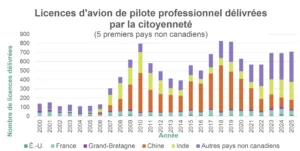
Transport Canada Data Analysis Canadian Pilot Training and Licensing Statistics in 2025/2026 Transport Canada presented its newest pilot training and licensing update at an ATAC meeting on June 3, 2026 — final 2025 licensing statistics along with updates on digital applications, Student Pilot Permits, flight test reports, training standards and civil aviation medical processing. Here’s

Pilot Bag
What is a pilot bag? A pilot bag is also known as a flight bag. It is a bag used by pilots at all stages in their flying to store the necessary pilot supplies used for their flights. Pilot bags come in a lot of different varieties while almost anything can be used as a