

Cold Front
A cold front is the leading edge of a cold air mass advancing and displacing a warmer air mass. Cold fronts are among the most significant weather-producing phenomena in aviation, generating rapid weather changes, turbulence, icing, and severe convection.
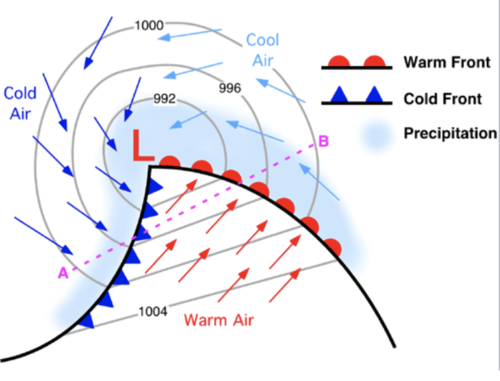
How a Cold Front Forms
A cold frontal boundary is relatively steep compared to a warm front — the dense cold air wedges sharply under the warmer air, forcing it rapidly upward. This steep lifting creates convective clouds rather than the stratiform layers typical of a warm front. The result is concentrated, often severe weather in a narrow band along the front.
Aviation Hazards Associated with Cold Fronts
- Convection and thunderstorms: Summer cold fronts generate squall lines and thunderstorms capable of producing severe turbulence, hail, microbursts, and tornadoes. Winter fronts produce snow squalls and whiteout conditions.
- Turbulence: Cold fronts are typically preceded by low-level jets, producing moderate to severe low-level wind shear in the frontal zone.
- Wind shift: A sharp wind shift (typically backing then veering) accompanies frontal passage — runway selection at uncontrolled aerodromes should account for this.
- Flash freeze: The temperature drop across a strong cold front can be sudden and dramatic — post-frontal temperatures may fall quickly enough to freeze standing water on runways.
- Icing: The convective activity along the front generates significant icing potential in cloud.
Cold Front Passage
As a cold front passes, conditions change rapidly: the wind shifts (typically from southwesterly to northwesterly in Canada), temperatures drop, pressure rises, and precipitation changes from rain to showers or snow. After passage, visibility often improves dramatically and convective activity diminishes as the cold air mass stabilizes.
On the TC Written Exam
Cold front characteristics are a core meteorology topic. Know: steep slope produces convection not stratus; weather narrows but intensifies compared to warm fronts; wind shift occurs on frontal passage; temperature drops; pressure bottoms out at the front then rises.
Related Terms
See also: Warm Front, Thunderstorm, Trough, Low-Level Jet, Icing.