

Microburst
A microburst is a localized, powerful column of descending air (downdraft) within a thunderstorm, less than or equal to 4 km in diameter and typically lasting less than 5 minutes. Despite its small size and brief duration, a microburst can generate winds exceeding 160 km/h and create a life-threatening shear environment for aircraft on approach or departure.
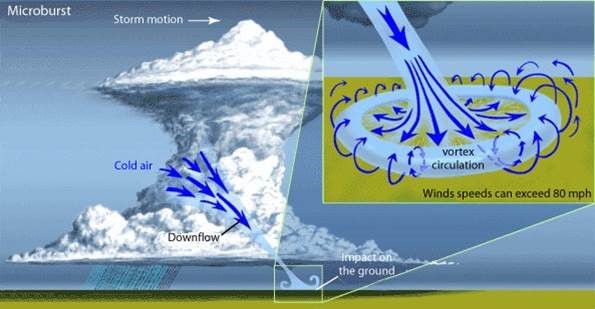
How a Microburst Affects an Aircraft
An aircraft flying through a microburst on approach encounters a characteristic sequence: first a headwind increase (causing an apparent performance gain — the aircraft gains airspeed and goes above the glidepath), then the core of the downdraft (pushing the aircraft down), then a tailwind as the aircraft exits on the far side (causing a sudden, severe airspeed loss and glidepath undershoot). This sequence is extremely dangerous at low altitude.
Formation
Microbursts are associated with thunderstorms. Conditions that promote intense downdrafts include: dry air at mid-levels that evaporates falling precipitation (evaporative cooling drives the downdraft faster), high freezing levels (precipitation falls farther and evaporates more), and instability at low levels. High-based thunderstorms over dry terrain are particularly likely to produce microbursts.
Detection
- PIREPs from preceding aircraft are the most timely warning
- Low-Level Windshear Alert System (LLWAS) at equipped airports detects outflow wind changes
- Doppler weather radar can detect the diverging outflow from a microburst
- Visual indicators: rain shaft beneath dark cloud base, virga (rain that evaporates before reaching the ground)
Response if Encountered
- Immediately execute a go-around — do not attempt to land through a microburst
- Apply maximum thrust
- Rotate to a go-around attitude and climb
- Fly through the shear rather than trying to correct back to the glidepath
- Declare an emergency if necessary
On the TC Written Exam
Microburst is a core topic in the meteorology section. Know: it’s a localized downdraft from a thunderstorm; the headwind-downdraft-tailwind sequence; maximum duration (5 minutes); maximum diameter (4 km); that it’s the most dangerous form of low-level wind shear.
Related Terms
See also: Low-Level Wind Shear, Thunderstorm, Low-Level Jet.