
Night Rating
The night rating is the most commonly added rating to a Private Pilot License in Canada, and for good reason. During night operations, pilots will not generally encounter rising air currents due to convection heating, making flying at night slightly smoother than daytime flying. Combine this with city lights on a clear night with the moon shining brightly, and you can get some stunning flight time in. Let’s look into what it takes to get a night rating in Canada.

Night Rating Requirements
This rating can be obtained once you have a private pilot license in Canada. The Canadian Aviation Regulations clearly outline the requirements as follows:
- 10 hours of night flight time which includes:
- 5 hours dual which includes 2 hours of cross country flight time
- 5 hours solo flight time which includes 10 takeoffs, circuits and landings, and
- 10 hours dual instrument time (total), 5 hours of which can be in a simulator
There is this interesting provision of in the standards which states that you can’t count any instrument time done at night towards your night rating. If you go flying dual with an instructor at night for 1.5 hours total time and you were under the hood for 1 hour of that time, 1 hour would count towards the 10 hour instrument requirements and 0.5 hours would count towards the 5 hours dual night time.
What to Anticipate Out of Training
Training to fly at night is pretty cool and things can get interesting. Your instructor will provide you with a preparatory ground instruction briefing on night operations and human factors. After this, your instructor will generally do one of two things: teach instrument flying at night or take you up to do some circuits so you can get used to the airplane. Before you go solo, your instructor will have wanted to cover some emergencies and abnormalities with you. These abnormal situations might include landing without a landing light working, electrical failures, or engine failures in the circuit.
As stated, your flight instructor may also being to introduce you to night flying with some instrument training at dusk or during absolute darkness, both of which are amazing!
Once you’ve shown your proficiency in the circuit and with the emergencies, you will generally go solo to complete your 5 hours. Note that there is no solo cross country requirement for the night rating, but I highly recommend it if you can.
At some point, it’ll be time for your dual cross country. As a part of this process, I highly encourage you to go somewhere that would expose you to such illusions like black holes. Being exposed to this in a controlled environment with your flight instructor will make your pilot training more fun, humble you a bit, and teach you an appreciation for human factors. Those pilots who are training towards a Commercial Pilot License should take this as an opportunity to push their own limits in a safe manner with their instructors.
After this, you may choose to complete a solo cross country or continue the remainder of your solo hours in the circuit. Combine this with instrument training and soon enough you have a night rating.
Night Rating Sign Off
The rating is given to you by an authorized person at your flight school or by Transport Canada directly. Once your training is complete and your instructor feels you have met the standards for the rating, the will sign your appropriate paperwork recommending you for the rating. An Authorized Person may be available at your flight school to issue you the rating, sign your license, and offer you temporary privileges until you new sticker comes in the mail.
You can also pay the fee online and mail in your application to a Transport Canada office. In this scenario, you do not get any temporary privileges and must wait until the sticker comes in the mail to fly solo or with passengers at night.
Lastly, you can choose not to get it signed off and just wait until you apply for an earn a Commercial Pilot License to get your flying privileges. This is not normally done by students but is occasionally completed in college programs.
Night Rating Currency
CAR 401.05 outlines the standards that need to be met to remain current for night flying.
To carry passengers and remain current at night, pilots must have completed a minimum of 5 take-offs and landings at night within the past 6 months.
Commercial Pilot/ATPL Training
We always recommend that any pilots who are pursuing careers in aviation to complete as much cross country time at night as possible. This is due to a legal requirement for pilots to apply for ATPL license which states that pilots must have a minimum of 25 hours of night PIC cross country to hold an ATPL in Canada.
If you are doing CPL training, do your night rating right after your PPL and build those night PIC cross country hours as much as you can.
Pilots who have not done this are often forced to rent an aircraft to build their night PIC cross country time even though they may meet all of the other requirements and have, oh, let’s say, 3,000 hours in Boeing 737s. Yes, true story. Pro tip if you are doing this, fly at or near flight for maximum endurance to prolong your air time while saving on gas.
Sharpe Aero Night Rating Book
SharpeAero has done it again, coming through with a highly-valuable flight training resource that plugs yet another hole in the Canadian flight training market – learning to fly at night.
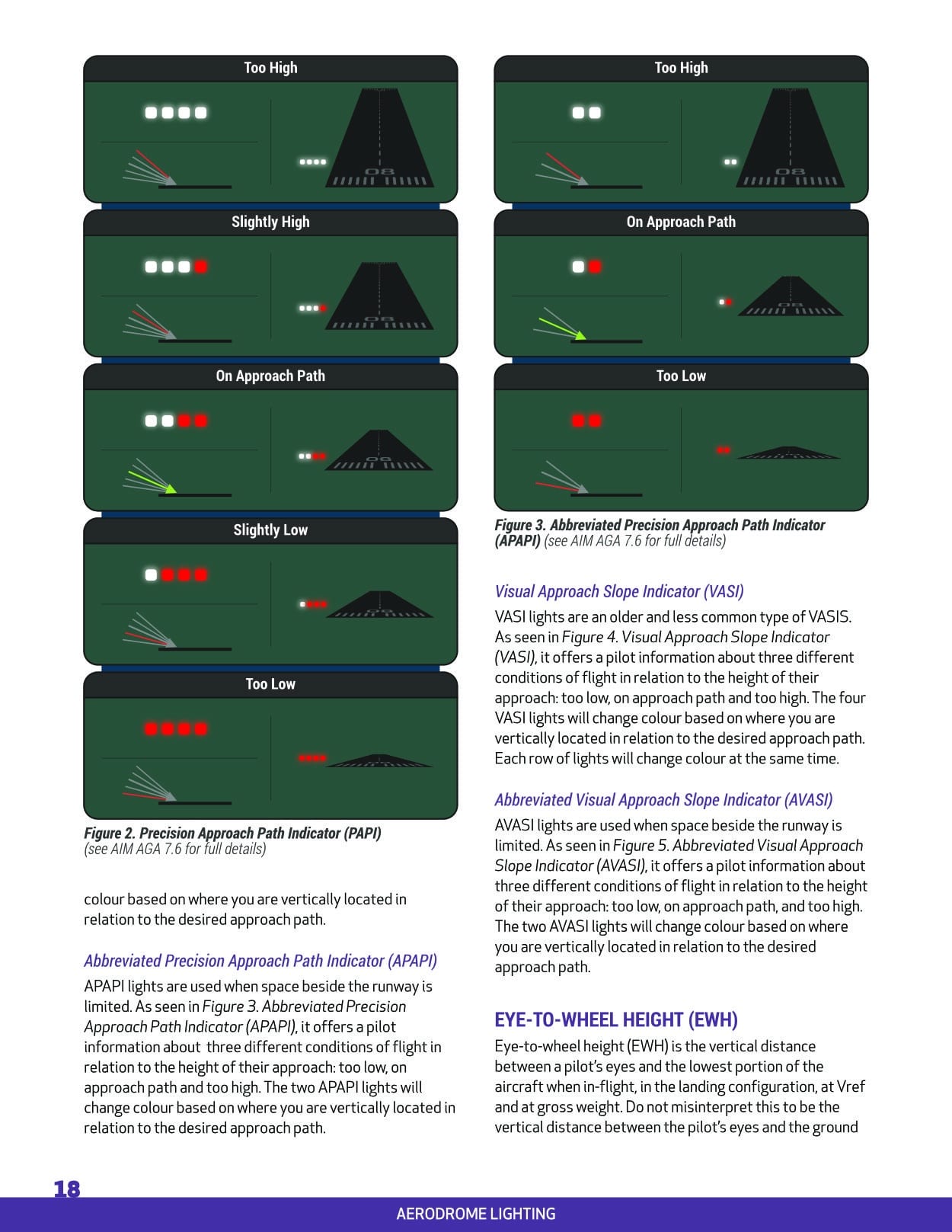
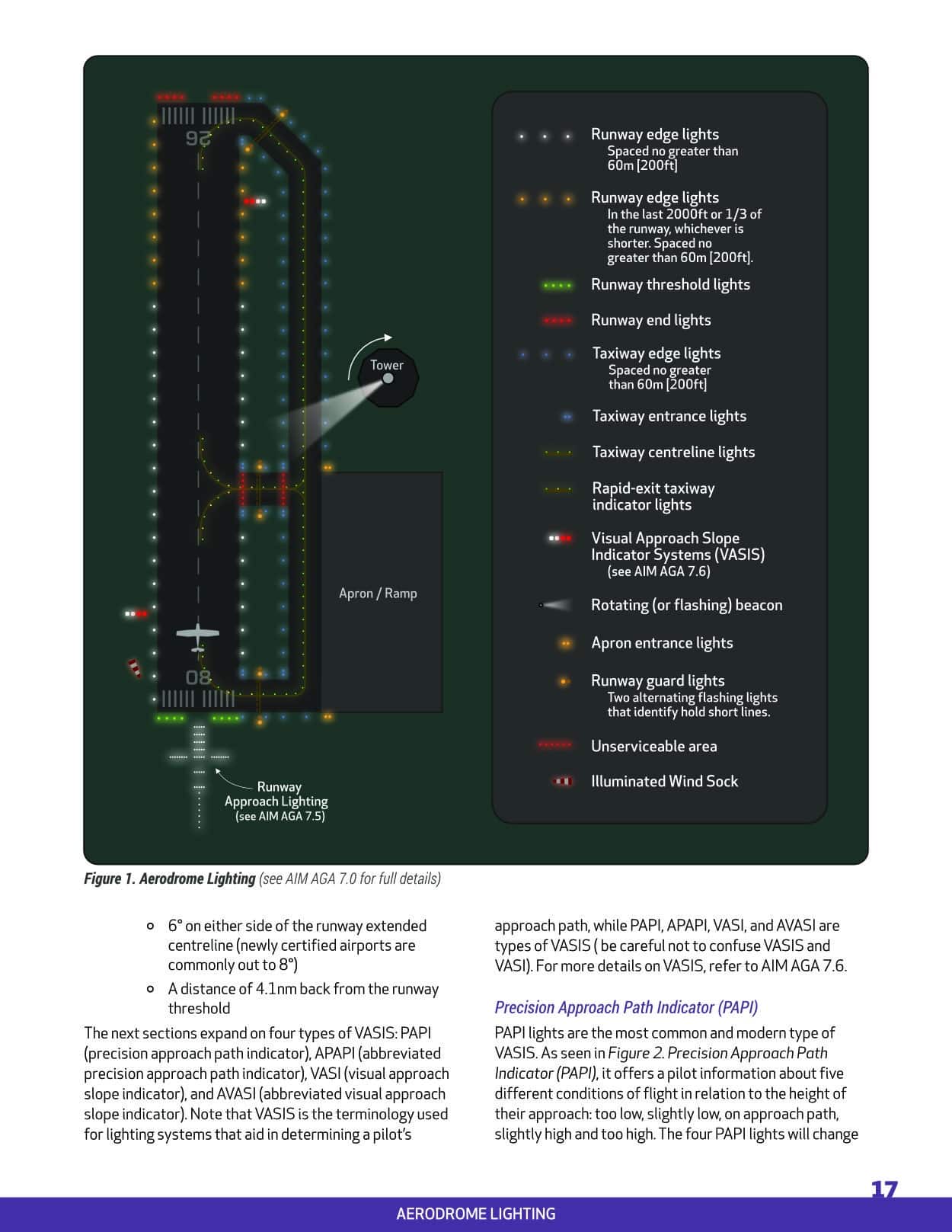
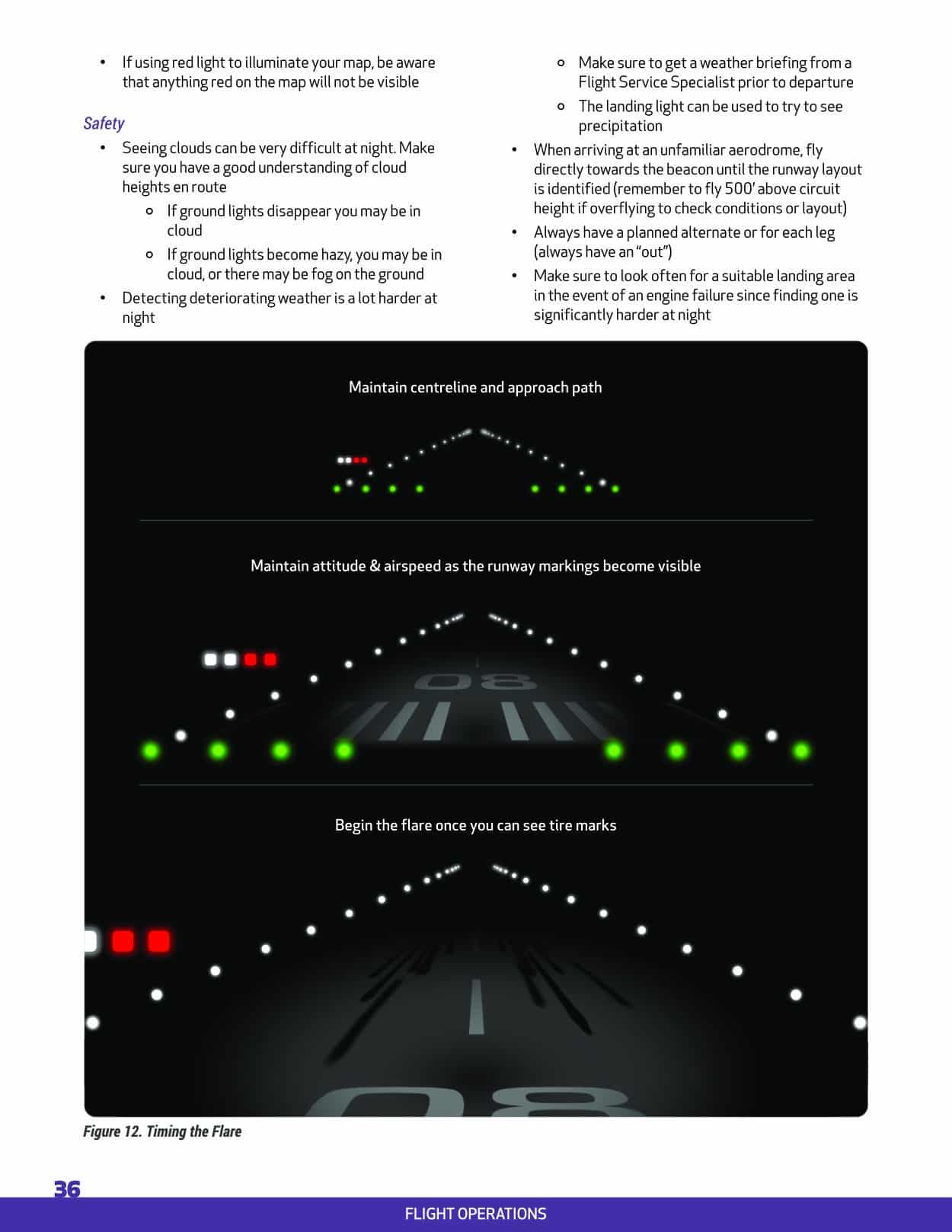
It’s hard to believe that before SharpeAero’s handbook, there was really no all-in-one guide for learning to fly at night in Canada. Sure, you could make piecework of the odd powerpoint deck here, or an old and outdated PDF word document there, but it never really covered all the bases, it wasn’t a well-organized and cohesive document. And it sure didn’t have great diagrams and visual aids.
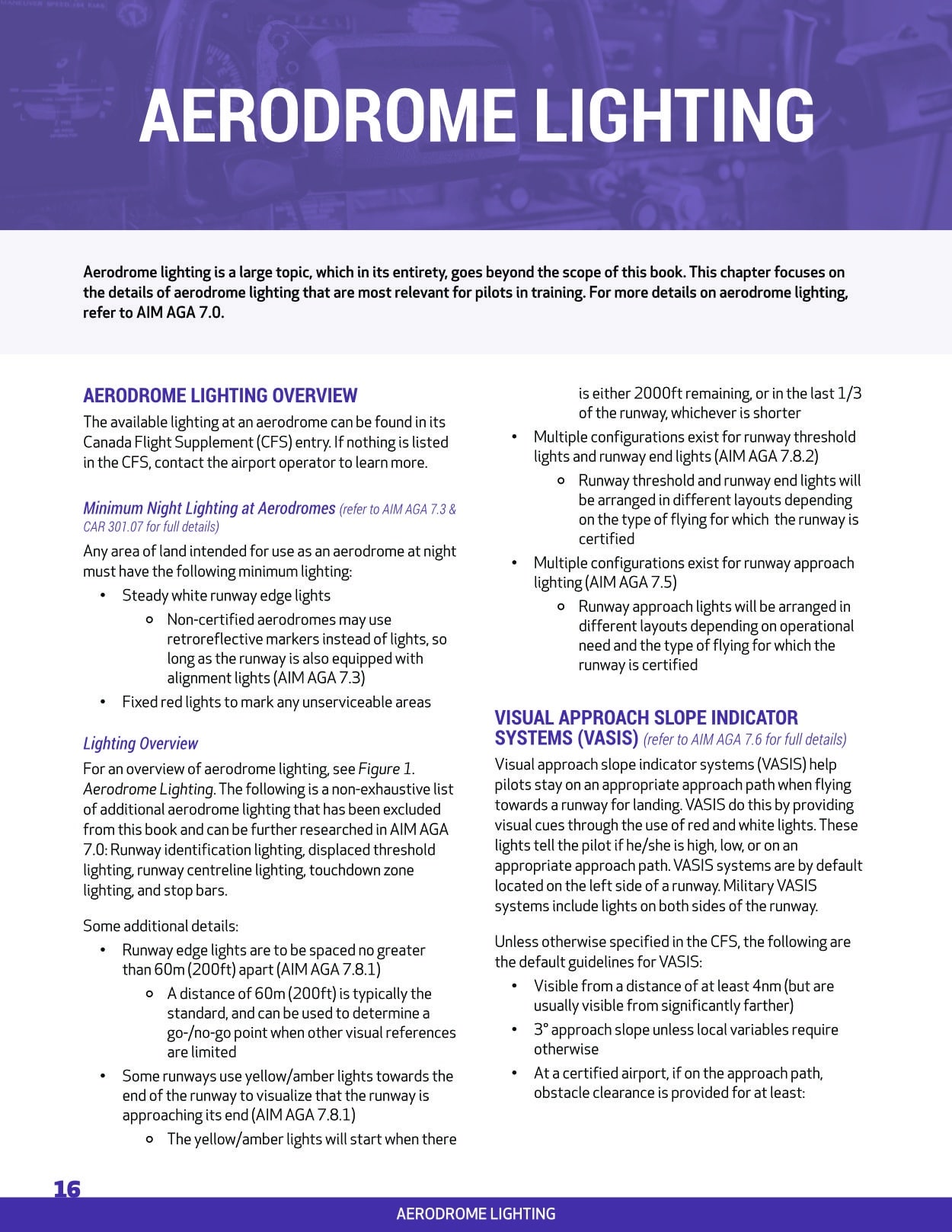
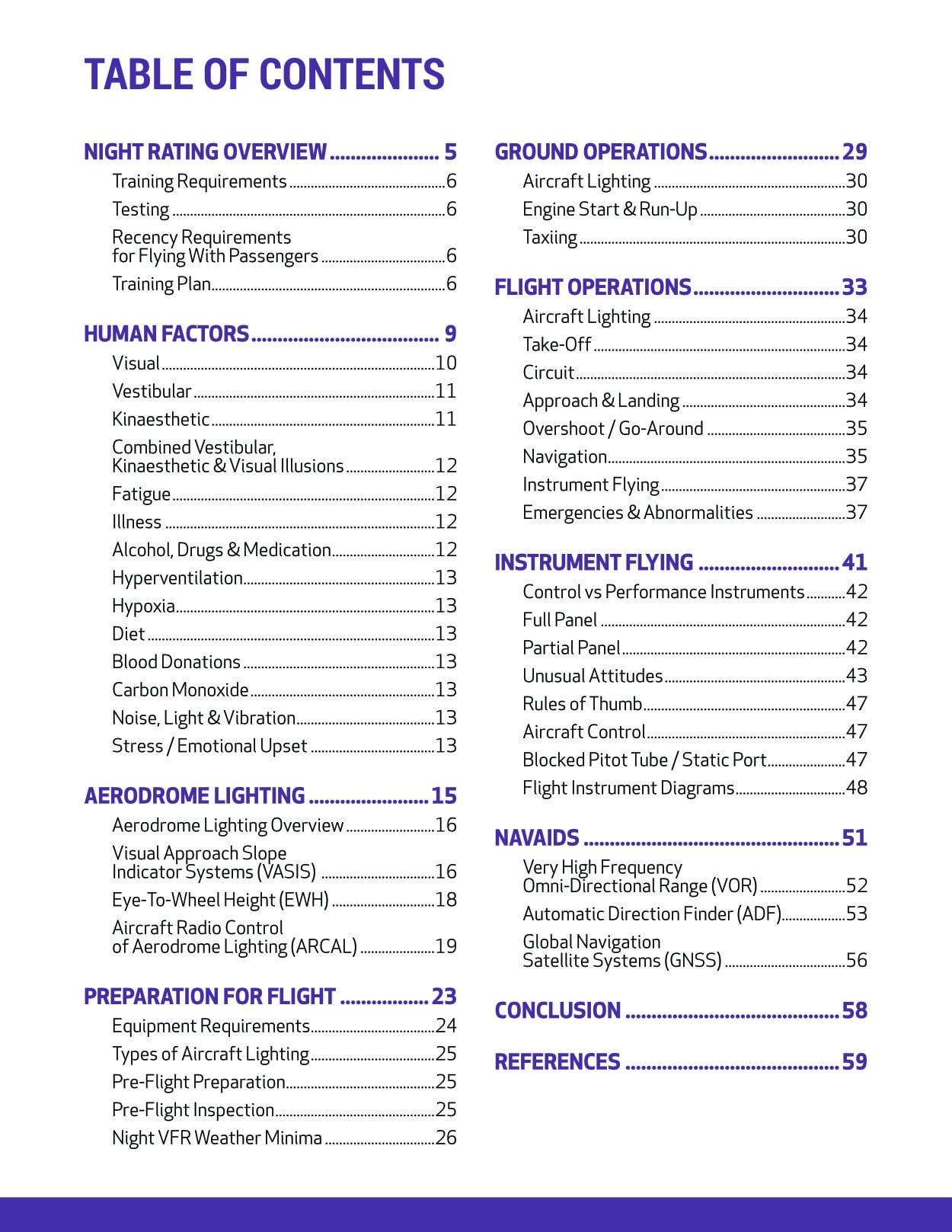
This is where SharpeAero comes in. They’ve earned a reputation for creating simple, focused and concise content, and this time around is no different. Their Night Rating handbook offers up all you need to know in order to prepare for learning to fly at night. The book covers the following topics: night rating overview, human factors, aerodrome lighting, preparation for flight, ground operations, flight operations, instrument flying, and NAVAIDs. We particularly like how SharpeAero uses bullet points throughout all of their books – it really helps make the content quick and easy to digest, and easy to sift through to find what you need.
This is definitely something every instructor should use as a teaching reference, and especially something every student should be using to prepare for their night rating training. Heck, if it saves you one hour on the ground with your flight instructor (and we think it will), it more than pays for itself. We will definitely be recommending this to all of our students. Go check it out.

Why Airlines May Suspend Cuba Flights During a Fuel Disruption
When jet fuel becomes unavailable across an entire country, the first question people ask is: “Why can’t the airline just bring more fuel with them?” In aviation, this strategy is called tankering – uplifting extra fuel at the initial departure airport so that the aircraft can arrive and still have enough fuel to safely depart

Pilot Bag
What is a pilot bag? A pilot bag is also known as a flight bag. It is a bag used by pilots at all stages in their flying to store the necessary pilot supplies used for their flights. Pilot bags come in a lot of different varieties while almost anything can be used as a

New Transport Canada Readback Rules: What Every Canadian Pilot Needs to Know
On November 20, 2025, Transport Canada published Advisory Circular (AC) 602-008 – Pilot Readback Requirements. It explains new rules that will soon affect every pilot operating in Canadian Domestic Airspace, from student pilots in the circuit to airline crews on the line. These changes haven’t “gone live” in the regulations yet, but they will become
Pilot Supplies to Begin Pilot Training
Pilot Supplies to Begin Pilot Training A lot of our new students contact us for assistance because of how overwhelming the pilot training process can be. One of the most common questions stems from which pilot supplies are needed to being training. There are a lot of options out there and it is sometimes hard

What Happens at an Aviation Medical?
A very common question we hear from new student pilots and even existing pilots is what happens at an aviation medical. For existing pilots, questions about the renewal process usually take center stage as the medical examination is the same as their initial medical exam but the paperwork is slightly different. Whether you’re starting flight
Pilot Licence Conversion: FAA to Transport Canada Made Easy
Converting an FAA Pilot Licence to Transport Canada If you’re a pilot who trained in the United States and are now looking north to Canada, you’ve probably wondered how to make your licence valid here. Whether it’s because you’re moving, you’ve married a Canadian, or you just want to expand your flying opportunities, converting an
Discover more from Canadian Flight Trainers
Subscribe to get the latest posts sent to your email.