

Angle of Incidence
On fixed-wing aircraft, the angle of incidence is the angle between the chord line of the wing where the wing is mounted to the fuselage and a reference axis along the fuselage.
Angle of incidence is the fixed angle at which a wing is bolted to the fuselage — specifically, the angle between the wing’s chord line and the aircraft’s longitudinal axis. The designer builds it into the airframe, and on virtually every aeroplane you will ever fly, it never changes. It is not the same thing as angle of attack, and confusing the two is the single most common mistake students make in theory of flight.
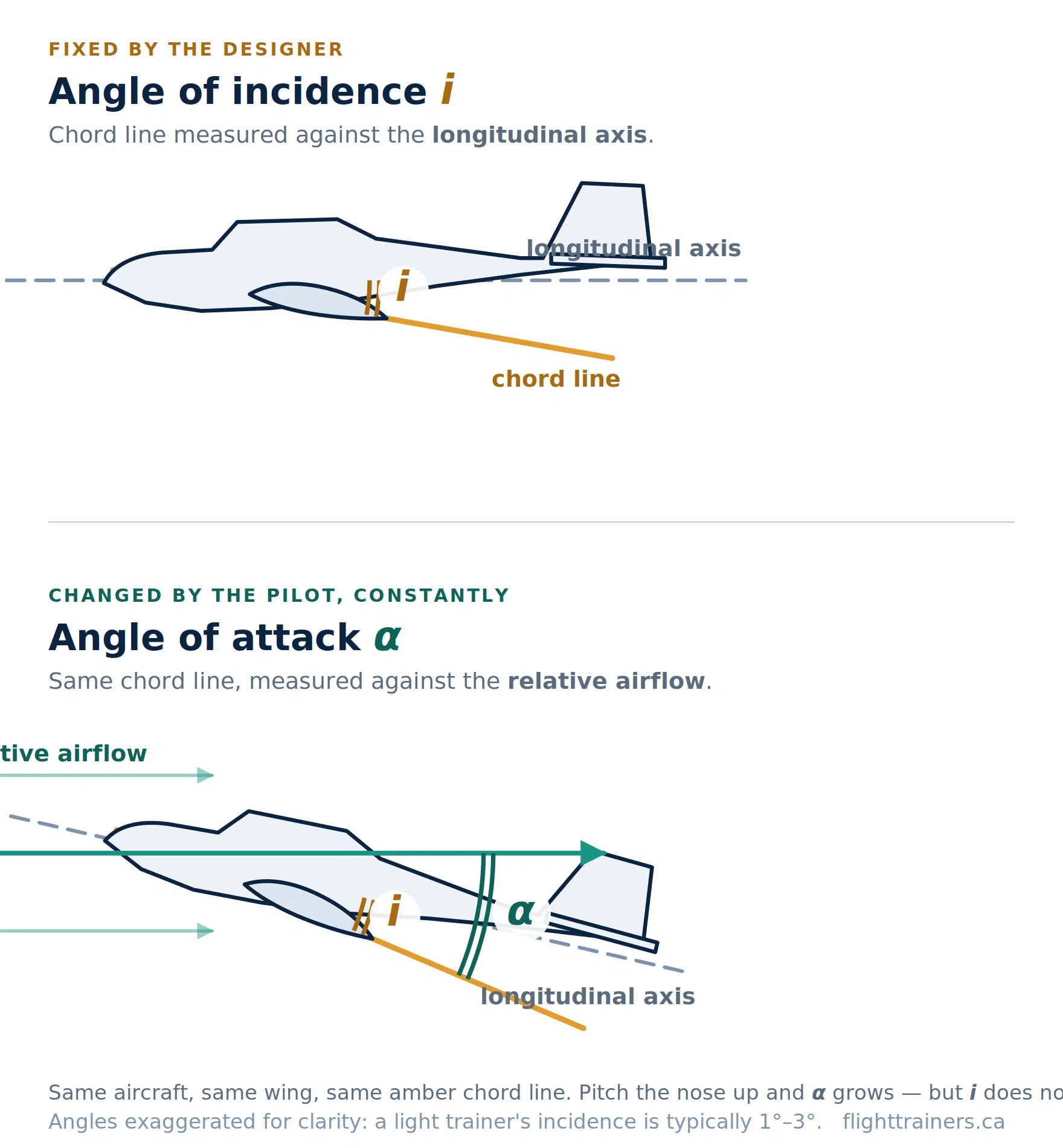
Angle of incidence vs. angle of attack
These two get muddled constantly, and it is worth killing the confusion early, because one of them is a dimension on a drawing and the other one is the thing that stalls your aeroplane.
| Angle of incidence | Angle of attack | |
|---|---|---|
| Measured between | The wing’s chord line and the aircraft’s longitudinal axis | The wing’s chord line and the relative airflow |
| Who sets it | The designer. It is a structural dimension, fixed when the aircraft is built and checked when it is rigged. | You do. Continuously, every time you move the control column or change the flight path. |
| Changes in flight? | No — with a handful of exceptions noted below. | Constantly. |
| Shown on an instrument? | Never. There is nothing to display. | Yes, on an angle of attack indicator. |
| Causes the stall? | No. | Yes. The wing stalls at its critical angle of attack — every time, at any airspeed, at any attitude, at any weight. |
| Typical value | Roughly 1° to 3° positive at the root on a light trainer. | Anything from negative to the critical angle, commonly around 15° to 17°. |
| Symbol | i (also called the rigging angle) | α (alpha) |
Incidence is measured against the aeroplane. Attack is measured against the air. If you remember nothing else, remember the reference.
How the two are related. They are not independent — the incidence is one of the terms that sets your angle of attack:
α = (θ − γ) + iwhere θ is your pitch attitude, γ is your flight path angle, and i is the angle of incidence. In steady level flight the flight path is horizontal, so γ is zero and the wing’s angle of attack is simply your pitch attitude plus the incidence. That is why a wing mounted at +2° is already working at 2° angle of attack while the fuselage sits dead level.
Why the wing is bolted on at a positive angle
A designer could mount the wing flush with the longitudinal axis. Almost none of them do, and there are three good reasons why.
1. The fuselage gets to fly straight. In cruise you want two things at once: the wing sitting at the angle of attack that produces exactly enough lift, and the fuselage aligned with the airflow so it isn’t ploughing through the air at an angle. A positive incidence buys you both. The wing does its job while the fuselage sits near the attitude where its drag is lowest. As a bonus, the cabin floor stays level.
2. You can see over the nose. Approach, landing and slow flight are all flown at high angles of attack. Every degree of incidence built into the wing is a degree of pitch attitude you don’t have to hold to get there — so the cowling stays lower and the runway stays in sight when you most need it.
3. The wing is already working on the takeoff roll. Before you rotate, the relative airflow is running straight down the runway and the aeroplane is sitting more or less level on its gear. In that moment the angle of incidence is the wing’s angle of attack. A wing with built-in incidence is already generating lift while the nosewheel is still on the tarmac.
How much incidence — and what washout has to do with it
Most light aeroplanes carry somewhere between 1° and 3° of positive incidence at the wing root. It is a small number. You would struggle to see it standing beside the aircraft, which is exactly why the diagram above exaggerates it.
Now walk out to the wing tip. On most training aircraft the incidence is not constant across the span — it is deliberately reduced from root to tip. That built-in twist has a name: washout. And washout is nothing more exotic than angle of incidence varying along the wing.
A Cessna 172 carries roughly 3° of washout. The consequence is worth understanding properly, because you have felt it. As you raise the nose and the angle of attack climbs, the root gets to the critical angle first. The inboard wing starts to separate and buffet while the tips — and the ailerons hanging off them — are still flying. You get a warning, you keep roll control into the stall, and the aeroplane is far less inclined to drop a wing and depart into a spin.
Build a wing the other way round, with more incidence at the tip than at the root, and you get wash-in: the tips stall first, the ailerons quit, and a wing drops. Nobody does that on purpose. So if you have ever wondered why a 172 mushes and shudders rather than snapping over — that is washout, and washout is angle of incidence.
The idea shows up in two more places worth knowing by name. On a biplane, the difference in incidence between the upper and lower wings is called decalage. And the difference in incidence between the wing and the horizontal stabiliser — sometimes called longitudinal dihedral — is one of the parameters that gives an aeroplane its longitudinal stability.
When the angle of incidence does change
“Fixed” is true for the wing on essentially every aircraft in a Canadian flight school fleet. It is not a law of physics, and the exceptions are instructive.
The Vought F-8 Crusader is the classic answer, and the one most likely to appear as a piece of trivia. Its entire wing pivots upward on approach, increasing the incidence so the wing can fly slowly while the fuselage — and the pilot’s view of the carrier deck — stays level.
The tailplane on almost every jet is the exception you will actually spend your career operating. Transport aircraft are trimmed with a trimmable horizontal stabiliser: the whole tailplane is driven up and down in flight, which is to say its angle of incidence is continuously varied. The wing’s incidence is a number on a drawing; the tailplane’s incidence is a live control, moving every time the aircraft trims. The stabilator on a Piper Cherokee is the same idea in miniature — an all-moving tailplane whose incidence changes with the control column.
A trap hiding in older textbooks
Some older British and Commonwealth aerodynamics texts use “angle of incidence” to mean what we call angle of attack, and reserve the phrase “rigger’s angle of incidence” for the mounting angle. Parts of the engineering literature still do it. If you are reading an older text, a technical paper or a maintenance manual and the numbers refuse to make sense, this is usually why.
For Canadian ground school and for your Transport Canada written exam, there is no ambiguity: angle of incidence means the fixed mounting angle, and nothing else.
On the Transport Canada written exam
Theory of flight is examinable on both the PPAER (private) and CPAER (commercial) written exams, and the incidence-versus-attack distinction is a standard place to lose an easy mark. The setup is always the same — a question describes an angle, and both terms are offered as answers.
Don’t try to memorise the definitions word for word. Anchor on the reference instead. If the angle is measured against a part of the aeroplane, it is incidence. If it is measured against the air, it is attack. That one question sorts every version of the trap.
The same material is covered in From the Ground Up under theory of flight, and the examinable knowledge areas are set out in Transport Canada’s study and reference guides — TP 12880 for the PPL and TP 12881 for the CPL.
Theory of flight, properly taught. Our Transport Canada‑accepted ground school covers aerodynamics the way it is actually examined — and the way it actually matters once you are flying. Study online, at your own pace, with instructor support when you need it.
Explore PPL Ground SchoolRelated terms
- Angle of Attack
- Angle of Attack Indicator
- Aerodynamic Coefficients
- Flight Path
- Load Factor
- Manoeuvring Speed
- Wing Tip Vortices
- Airframe
- Canard
- Empennage
Frequently asked questions
What is the difference between angle of incidence and angle of attack?
Angle of incidence is the fixed angle between the wing’s chord line and the aircraft’s longitudinal axis — a structural dimension, built in by the designer, that does not change in flight. Angle of attack is the angle between the same chord line and the relative airflow, and it changes continuously as you move the nose or alter the flight path. Incidence is measured against the aeroplane; attack is measured against the air. The wing stalls at a critical angle of attack, never at a critical angle of incidence.
Does the angle of incidence change in flight?
On the wing, no — not on any aircraft you are likely to train in. It is fixed when the aircraft is built. The exceptions are rare: the Vought F-8 Crusader had a variable-incidence wing that pivoted up for approach. The tailplane is a different story, though: transport aircraft trim using a trimmable horizontal stabiliser, whose incidence genuinely does change in flight, and an all-moving stabilator does the same thing on a Piper Cherokee.
Does increasing the angle of incidence increase lift?
Not by itself. For a given angle of attack and airspeed, the wing produces the same lift regardless of how it is mounted. What a larger angle of incidence changes is the fuselage attitude required to fly at that angle of attack — the nose sits lower. That is a drag and visibility benefit, not a lift benefit. Lift comes from angle of attack and airspeed.
What is a typical angle of incidence on a light aircraft?
Roughly 1° to 3° positive at the wing root on most light trainers, with the exact figure set by the designer and recorded in the aircraft’s type certificate data sheet. It is a deliberately small number — enough to let the fuselage cruise near level, not so much that the aircraft flies nose-down.
Is washout the same as angle of incidence?
Washout is a change in angle of incidence along the wing. The tip is rigged at a lower incidence than the root, so the root reaches the critical angle of attack first and stalls first. That keeps the tips and the ailerons flying as the stall develops, which preserves roll control and makes the aircraft far more resistant to dropping a wing. A Cessna 172 has around 3° of washout.
Why do some textbooks use “angle of incidence” to mean angle of attack?
Older British and Commonwealth aerodynamics texts, and some engineering literature, use “angle of incidence” for the angle between the chord and the airflow — what we call angle of attack — and call the mounting angle the “rigger’s angle of incidence”. It is a genuine source of confusion when reading older material. In Canadian ground school and on Transport Canada written exams, angle of incidence always means the fixed mounting angle.