

Lee Wave
A lee wave (mountain wave) is a series of stationary atmospheric waves that form on the downwind (lee) side of a mountain range when stable air flows over the terrain. Lee waves can produce severe turbulence, extreme vertical currents, and one of the most dangerous meteorological phenomena in aviation — rotor turbulence.
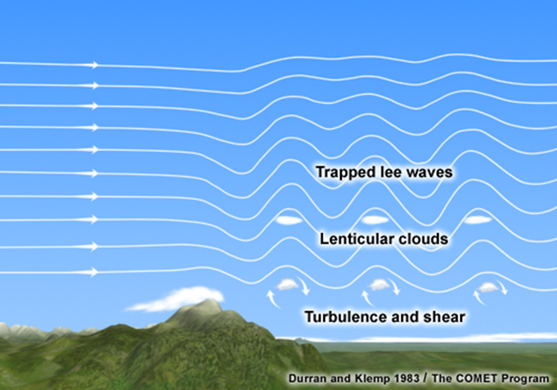
How Lee Waves Form
When a stable air mass with adequate wind speed (typically >25 knots at mountain height) crosses a mountain range perpendicular to the ridge, the air is displaced upward. Instead of mixing and dissipating, the stable air oscillates like a wave — undulating up and down for hundreds of miles downwind. Wave crests may be marked by distinctive lenticular (lens-shaped) clouds; wave troughs may be clear.
Components and Hazards
- Wave crests: Rising air — strong updrafts; lenticular (lens-shaped) cloud may form
- Wave troughs: Descending air — strong downdrafts that can exceed aircraft climb capability
- Rotor zone: Below the first wave crest, immediately downwind of the mountain — violently turbulent horizontal vortex; the most dangerous component; rotor turbulence can be severe to extreme
- Cap cloud: Stationary cloud over the mountain ridge; indicates wave conditions exist
Canadian Context
Lee wave activity is significant in British Columbia (Rocky Mountains, Coast Mountains), Alberta (eastern slopes of the Rockies), and parts of Quebec and Newfoundland (Appalachians). The eastern slope of the Rockies generates some of the most severe wave activity in North America, particularly in winter and spring when the jet stream aligns with the ridgeline.
Recognizing and Avoiding Lee Waves
- Lenticular clouds (UFO-shaped, stationary) indicate wave activity
- Banner clouds streaming from mountain peaks indicate strong cross-mountain flow
- Cap cloud over the summit is a warning sign
- PIREPs are the best real-time information on wave intensity
- SIGMETs are issued for severe mountain wave turbulence
- If encountered: reduce to VA, maintain a level attitude (don’t fight the altitude changes), get clear of the wave if possible
On the TC Written Exam
Lee wave / mountain wave is a high-priority meteorology topic. Know: conditions required (stable air + strong cross-mountain wind); the rotor zone as the most dangerous area; lenticular clouds as indicators; recommended speed (VA) if encountered.
Related Terms
See also: Mountain Wave, Clear Air Turbulence, SIGMET, Maneuvering Speed.