

Mountain Wave
A mountain wave (lee wave) is a series of stationary atmospheric waves that develop on the downwind side of a mountain range when stable air flows over the terrain. Mountain waves can extend hundreds of miles downwind and reach from near the surface to the stratosphere. They produce some of the most severe turbulence encountered in aviation.
Formation Conditions
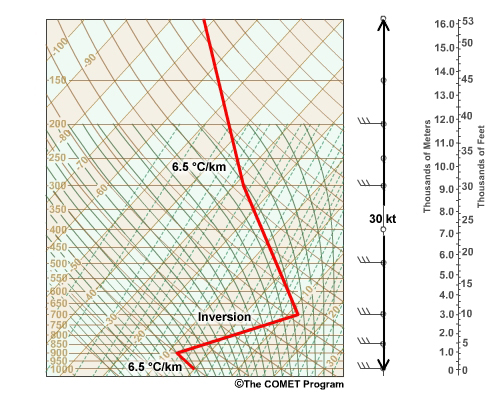
- Stable air (inversion or stable layer) that can oscillate
- Strong winds (typically >25 knots at mountain height) perpendicular to the ridge
- Wind speed generally increasing with altitude
Mountain Wave Hazards
- Rotor turbulence: Violently turbulent horizontal vortex below the first wave crest; extreme turbulence possible
- Severe downdrafts: In wave troughs, sink rates can exceed 2,000 ft/min — more than most aircraft can climb to overcome
- Structural damage: Severe mountain wave turbulence (SIGMET criteria) has caused catastrophic structural failure
- Icing in wave cloud: Lenticular and cap clouds contain supercooled water and significant icing potential
Visual Indicators
- Lenticular (lens-shaped) clouds, stationary at wave crests
- Cap cloud over and downwind of the mountain ridge
- Banner clouds streaming from peaks
- Rotor cloud — ragged, turbulent-looking cloud below the lenticular at low level
Avoidance and Survival
If mountain wave conditions are forecast or suspected: plan to cross the ridge at altitude well above the wave amplitude; cross perpendicular to the ridge at a high power setting to allow escape if severe downdraft is encountered; avoid the rotor zone at all costs; slow to VA if turbulence is encountered and maintain a level attitude. If unable to maintain altitude in a downdraft, do not try to climb — turn away from the terrain.
On the TC Written Exam
Mountain waves are extensively tested. Know: formation conditions; rotor as the most dangerous component; lenticular clouds as the visual indicator; recommended speed (VA) in turbulence; SIGMET issued for severe wave activity.
Related Terms
See also: Lee Wave, Clear Air Turbulence, SIGMET.