Recreational Pilot Permit Vs Private Pilot License
Here is a direct comparison of a Recreational Pilot Permit Vs a Private Pilot License
Minimum Age
Recreational Pilot Permit: Minimum 16 years old
Private Pilot License: Minimum 17 years old
However, students may begin their flight training before this age.
Medical Requirement
Recreational Pilot Permit: Minimum Category 4, 3, or 1.
Private Pilot License: Minimum Category 3 or 1.
Minimum Flight Training Requirement
Recreational Pilot Permit: 25 hours consisting of 15 hours dual flight instruction and 5 hours solo
Private Pilot License: 45 hours consisting of 17 hours dual flight instruction and 12 hour solo.
Dual flight instruction means time spent being taught by a licensed flight instructor. Solo refers to time spent by yourself in an aircraft practicing flight maneuvers. The times listed are minimums and most students will fly well over the posted Transport Canada requirements.
Ground School Requirement
Recreational Pilot Permit: There is no formal requirement, however students must write and pass the Pilot Permit – Recreational – Aeroplane exam (RPPAE exam is 80 questions) or the Private Pilot License -(PPAER exam is 100 questions). Most students choose to enrol in the Canadian Flight Trainers Private Pilot Ground School Course to gain the necessary theoretical and practical knowledge to write the exam.
Private Pilot License: Students must complete a minimum of 40 hours of ground school and they must obtain a minimum of 60% on the Private Pilot Licence – Aeroplane (PPAER) exam. Most students enrol in our Private Pilot License Ground School Course to complete this requirement.
Skill Requirement
Recreational Pilot Permit: Must complete the Recreational Pilot Permit or Private Pilot License Flight Test
Private Pilot License: Must complete the Private Pilot Flight Test
Flight tests are done with a Transport Canada Inspector or Transport Canada designated flight test examiner.
Privileges and Limitations
Recreational Pilot Permit
- Maximum of 1 passenger
- Cannot fly and airplane with more than 4 seats
- Fly in Canada only
- Only add a float rating
- Cannot fly for money
Private Pilot License
- No passenger limit
- Fly any non-high performance airplane
- Fly world wide
- Ability to add night rating, multi-engine rating, instrument rating, and float ratings
- Cannot fly for money
Summary
While the recreational pilot permit may seem like a better choice due to the lower requirements, the amount of time spent in flight training will only be slightly less than that of a private pilot license. With many of the same exercises having to be completed and for slightly more money, you can have the extended privileges that come with having a Private Pilot License in Canada.


Air Canada Pilot Salary: How Much Air Canada Pilots Make in 2026
Updated September 2026 for the current Air Canada pilot contract. This article was written by a guest columnist who works at Air Canada as a Captain on a narrow body aircraft. He has made extensive contributions to our Commercial Pilot Ground School but always chooses to keep a low profile on the internet. Every number

How to Calculate Cloud Bases
Aviation Weather How to Calculate Cloud Bases: The Formula Every Pilot Should Know Weather and clouds play a big role in aviation, and one of the most useful skills a pilot can learn is how to quickly calculate cloud bases. Here is the formula, where its numbers come from, and the one change Transport Canada

Night Rating Requirements in Canada
The night rating is the most commonly added rating to a Private Pilot License in Canada, and for good reason. During night operations, pilots will not generally encounter rising air currents due to convection heating, making flying at night slightly smoother than daytime flying. Combine this with city lights on a clear night with the

AWWS GFA
AWWS was retired on February 28, 2024. NAV CANADA’s Aviation Weather Web Site no longer exists. Everything it did now lives on CFPS — the live GFA links below are current and working. If you typed “AWWS” into a search engine and landed here, you’re probably looking for NAV CANADA’s Aviation Weather Web Site —

Commercial Pilot Ground School – What Our Students Expect
Commercial Pilot Ground School Research What Students Expect From CPL Ground School: 260 Responses Analyzed Commercial students arrive with a licence, some experience, and much less patience for wasted time. We analyzed what they expect from the course, the instructors, and themselves. View CPL Ground School See the Findings 260written CPL Ground School sign-up responses
Private Pilot Ground School – What Students Expect
Private Pilot Ground School Research What Students Expect From PPL Ground School: 1,000+ Responses Analyzed Before students begin our Private Pilot Ground School, we ask what they hope to achieve and what they expect from us. Their answers are a useful look at what new pilots actually need from ground school. See the Findings View
Canadian Pilot Training and Licensing Statistics in 2025/2026
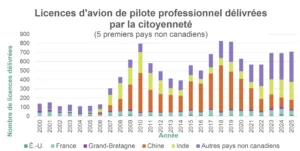
Transport Canada Data Analysis Canadian Pilot Training and Licensing Statistics in 2025/2026 Transport Canada presented its newest pilot training and licensing update at an ATAC meeting on June 3, 2026 — final 2025 licensing statistics along with updates on digital applications, Student Pilot Permits, flight test reports, training standards and civil aviation medical processing. Here’s

Pilot Bag
What is a pilot bag? A pilot bag is also known as a flight bag. It is a bag used by pilots at all stages in their flying to store the necessary pilot supplies used for their flights. Pilot bags come in a lot of different varieties while almost anything can be used as a