Transport Canada Aviation Medical
Transport Canada Aviation Medical
When first starting out in aviation, students are very overwhelmed with the amount of information they are required to absorb, a new way of learning, and of course the endless amount of tasks they have to worry about when they go home. From studying their Flight Training Manuals to getting ready for their ROC-A Exam; then there is talk of this PSTAR exam and the dreaded Transport Canada aviation medical.
So let’s get into it and look at what is required from you as a new pilot entering aviation. There are four categories of Transport Canada aviation medicals:
- Category 1 Medical: Mostly used by Airline Pilots and Commercial Pilots
- Category 2 Medical: Used only by Air Traffic Controllers
- Category 3 Medical: Mostly used by Private Pilots and Recreational Pilots.
- Category 4 Medical: Used by Recreational Pilot Permit Holders and student pilots.
As you become more of an impact to the public, your medical requirements will increase. The highest category of medical is the Category 1 Medical. Airline and commercial pilots flying the paying public must meet very stringent medical standards in order to safely fly. However, student pilots just learning how to fly only require a Category 4 Transport Canada Aviation Medical, or a medical declaration; the standards are much lower than a Category 1 medical.
I’m a Student, Which Transport Canada Aviation Medical do I Need?
As a student pilot, you at minimum require a Category 4 Medical. We’ll get to that a little bit later. If you are wanting to obtain a private license or become a commercial pilot, you should complete your Category 1 or 3 Medical now to verify you meet the proper standards. It is uncommon but it can happen where student pilots begin flight training only to find out from Transport Canada that they are unable to hold the required medical certificate. Find out now.
Where can I do my Transport Canada Aviation Medical?
Aviation medicals can only be done by Civil Aviation Medical Examiners. Just like your family doctor can’t perform heart surgery on you (although yours might), not all family doctors are qualified to conduct aviation medicals. To find a medical examiner or aviation medical clinic near you, visit the Transport Canada website here.
It will cost money, and this is normal. For a category 1 medical, you will be required to do an ECG and a hearing test at your own cost.
The Category 4 Medical

If you are a relatively healthy person and are confident that you can hold a medical, we highly suggest you work right now on your category 4 medical. This is also known as a Medical Declaration. Essentially, fill out Part A of the form, print it and visit your family doctor. Better yet, if you have known them for a long time and they know your medical history, you might be able to fax/e-mail to them and have them fill it out.
All the doctor is doing is declaring that to the best of their knowledge, you have never met any of the conditions in Part 2. This should not require an exam, a hearing test or anything. It is a declaration. It is paperwork. This should be free, although some doctor’s offices may charge you for completing paperwork.
Once the form is completed and your family doctor has signed Part C, it is time to mail it in or scan and send via e-mail to your local Transport Canada office. Normally we would make the e-mails accessible to you by listing them here, but they change at the whim of a new Minister of Transport and our page would never be up to date. So instead, visit the Transport Canada aviation medical contact page and find the e-mail of your regional Medical Office AND Regional Service Center. We recommend e-mail the same form to BOTH e-mails although we have been told to only send them to the Regional Service Centers.
What’s the advantage of a Category 4 Medical Form?
Completing a Category 1 or 3 Medical can take some time. By the time the appointment gets booked, you get your ECG/Audiogram done if required, it is sent to Transport Medicine, processed and sent back to you, it could be up to 6 months or more. With the Covid related pandemic, 6 months was what lucky people dealt with in some parts of the country. So the main advantage? Time.
As a student pilot, you can complete ALL of your training towards your Private Pilot License, including your exam and flight test with a Category 4 Medical. However, you cannot actually be issued a license until you hold a valid Category 3 or 1 medical. This means that while you wait for the paperwork to be processed for your Category 1 or 3 medical, you won’t be held up at your first solo or at any part of your flight training. Once you obtain a Category 4 Medical, you will get a license number from Transport Canada which will be used on your Student Pilot Permit. This 6 digit number will also be used to on all of your government paperwork including your letter of recommendations and exam.

Commercial Pilot License in Canada: What is it and why do you need it?
Pilot Careers Commercial Pilot License in Canada: What It Is and How to Get One For many people, earning a commercial pilot license is the moment an aviation hobby turns into a career. A CPL is the foundation of a pilot’s professional flying journey. But what exactly is a commercial pilot license, why is it

Air Canada Pilot Salary: How Much Air Canada Pilots Make in 2026
Updated September 2026 for the current Air Canada pilot contract. This article was written by a guest columnist who works at Air Canada as a Captain on a narrow body aircraft. He has made extensive contributions to our Commercial Pilot Ground School but always chooses to keep a low profile on the internet. Every number

How to Calculate Cloud Bases
Aviation Weather How to Calculate Cloud Bases: The Formula Every Pilot Should Know Weather and clouds play a big role in aviation, and one of the most useful skills a pilot can learn is how to quickly calculate cloud bases. Here is the formula, where its numbers come from, and the one change Transport Canada

Night Rating Requirements in Canada
The night rating is the most commonly added rating to a Private Pilot License in Canada, and for good reason. During night operations, pilots will not generally encounter rising air currents due to convection heating, making flying at night slightly smoother than daytime flying. Combine this with city lights on a clear night with the

AWWS GFA
AWWS was retired on February 28, 2024. NAV CANADA’s Aviation Weather Web Site no longer exists. Everything it did now lives on CFPS — the live GFA links below are current and working. If you typed “AWWS” into a search engine and landed here, you’re probably looking for NAV CANADA’s Aviation Weather Web Site —

Commercial Pilot Ground School – What Our Students Expect
Commercial Pilot Ground School Research What Students Expect From CPL Ground School: 260 Responses Analyzed Commercial students arrive with a licence, some experience, and much less patience for wasted time. We analyzed what they expect from the course, the instructors, and themselves. View CPL Ground School See the Findings 260written CPL Ground School sign-up responses

Private Pilot Ground School – What Students Expect
Private Pilot Ground School Research What Students Expect From PPL Ground School: 1,000+ Responses Analyzed Before students begin our Private Pilot Ground School, we ask what they hope to achieve and what they expect from us. Their answers are a useful look at what new pilots actually need from ground school. See the Findings View
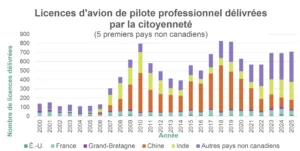
Canadian Pilot Training and Licensing Statistics in 2025/2026
Transport Canada Data Analysis Canadian Pilot Training and Licensing Statistics in 2025/2026 Transport Canada presented its newest pilot training and licensing update at an ATAC meeting on June 3, 2026 — final 2025 licensing statistics along with updates on digital applications, Student Pilot Permits, flight test reports, training standards and civil aviation medical processing. Here’s