

Clear Air Turbulence
Clear air turbulence (CAT) is turbulence encountered in airspace devoid of cloud — particularly in or near the jet stream and in mountain wave activity. It cannot be detected by the naked eye or by conventional weather radar, making it one of the most hazardous and unpredictable of all weather phenomena for aircraft.
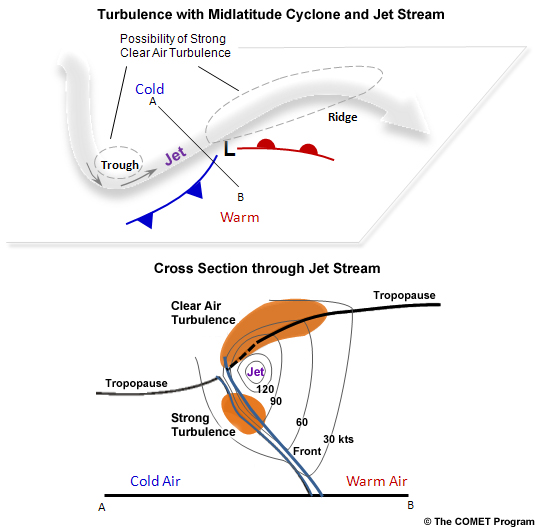
Causes
- Jet stream wind shear: The primary source of CAT; occurs in areas of rapidly changing wind speed or direction near the jet core. Vertical wind shear ≥ 10–14 kt/1,000 ft produces moderate CAT; ≥ 15 kt/1,000 ft produces severe CAT.
- Mountain waves: Turbulence in the wake of mountain ranges, potentially extending hundreds of miles downwind and to great heights
- Thermal convection: Turbulence above thunderstorms extending into the stratosphere
Where CAT Is Most Likely
- Within 4° of latitude (approximately 240 NM) of the jet stream core
- On the cyclonic (poleward) side of the jet — greater wind shear
- Near jet streaks (localized cores of maximum wind within the jet)
- Where the jet stream bends sharply around ridges and troughs
- In the 5,000 ft layer above and 3,000 ft below the tropopause
CAT Intensity and Seasonal Variation
CAT is more severe and frequent in winter, when the temperature contrast between poles and equator is greatest and the jet stream is stronger. Wind speed deceleration of 50 kt or more within 4° latitude is a reliable indicator of moderate-to-severe CAT potential.
Detection and Avoidance
- CAT cannot be detected by weather radar — it contains no moisture
- PIREPs (pilot weather reports) are the primary real-time source of CAT information
- SIGMETs are issued for severe CAT (moderate CAT may appear in AIRMETs)
- If CAT is encountered, reduce to maneuvering speed (VA) and fly a constant attitude
- Changing altitude by 2,000–4,000 ft often exits the CAT layer
On the TC Written Exam
CAT is tested in the meteorology section. Key points: found near jet stream, especially on the cyclonic side; not detectable by radar; PIREPs are the best real-time information; reduce to VA if encountered.
Related Terms
See also: Jet Stream, Mountain Wave, SIGMET.