
Canadian Pilot Training and Licensing Statistics in 2024/2025
Transport Canada’s latest Pilot Training and Licensing Statistics reveal an interesting picture of the aviation training sector. The newest statistics were made available during an ATAC Flight Training Committee meeting held in May of 2025. The newest statistics show a rebound after a pandemic-era decline and shifting demographics in licence holders. This article will offers valuable insights for flight schools, instructors, and aspiring pilots and is based on the Canadian pilot licensing statistics offered by Transport Canada.
1. A Strong Rebound in Aeroplane Licensing
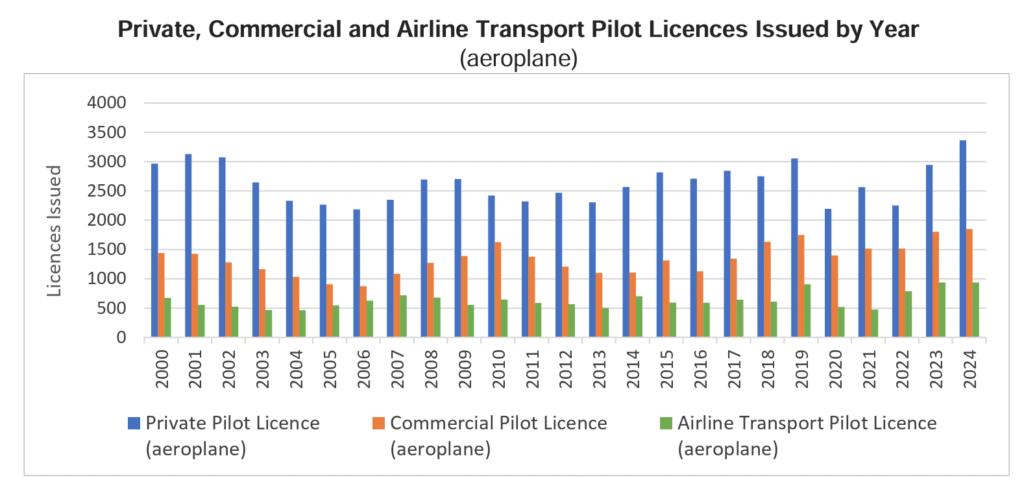
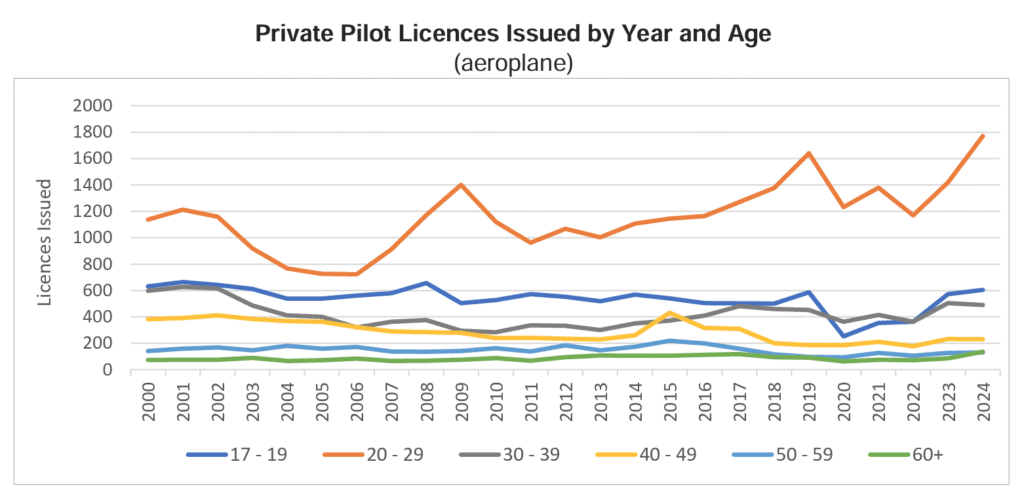
In 2024, Private Pilot Licence (PPL) issuances for aeroplanes surged to 3,363, marking the highest total in more than two decades. This represents a 14% increase over 2023 and a significant recovery from the pandemic low of 2,191 in 2020.
The Commercial Pilot Licence (CPL) category also grew, reaching 1,849 issuances in 2024 — up 2.7% from the previous year. The Airline Transport Pilot Licence (ATPL) saw a modest increase to 936, continuing a gradual upward trend that began after the sharp drop in 2020.
This growth reflects a strong return in student enrolment, likely driven by industry hiring demand, particularly among regional carriers and charter operators.
2. Helicopter Licensing Remains Stable, But Lower Than Peak Years
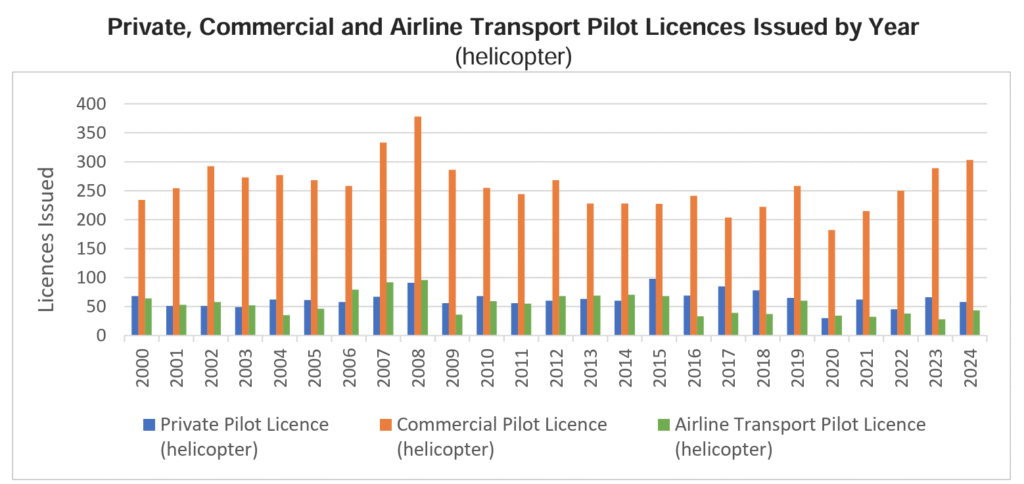
Helicopter pilot licensing numbers tell a different story. Private Pilot Licence (Helicopter) issuances fell slightly to 58 in 2024, down from 66 in 2023. The CPL (Helicopter) category increased marginally to 303, and ATPL (Helicopter) grew to 43, but overall volumes remain far below mid-2000s highs.
This relative stagnation likely reflects higher training costs, a smaller market for helicopter operations, and limited entry-level job opportunities compared to the fixed-wing sector.
3. The Demographic Shift: Younger Pilots Leading the Way
One of the most telling data points is the age distribution of newly issued licences.
For aeroplane PPLs in 2024:
- 20–29 year-olds accounted for more than half of all new licences (1,770 out of 3,363).
- The 17–19 group showed renewed growth (605 licences), possibly driven by integrated high school–college aviation programs.
CPL issuance follows a similar trend, with 20–29 year-olds dominating (1,328 out of 1,849). The older age brackets (40+) make up only a small fraction of new commercial pilots, suggesting that career-change entrants remain rare.
For ATPLs, the largest group is 30–39 year-olds (374), followed closely by 21–29 year-olds (401) — an indicator of pilots progressing through the traditional career pipeline from CPL to ATPL over a decade or less.
4. Gender Representation: Gains, But Still a Long Way to Go
The gender distribution highlights ongoing underrepresentation of women in aviation.
In 2024:
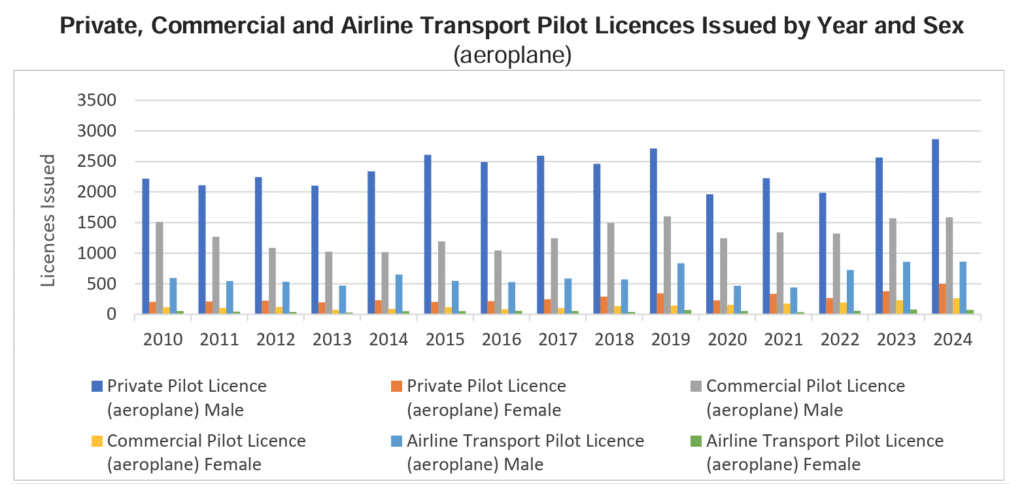
- Women accounted for 14.8% of new aeroplane PPLs (499 out of 3,363).
- Only 14.1% of new CPLs were female (261 out of 1,849).
- Female ATPL issuance dropped slightly to 7.7% (72 out of 936).
While there is a gradual upward trend over the long term, the pace of change remains slow. Targeted outreach and mentorship programs may be key to encouraging more women to pursue aviation careers.
5. Citizenship Trends: Non-Canadian Pilots Play a Major Role
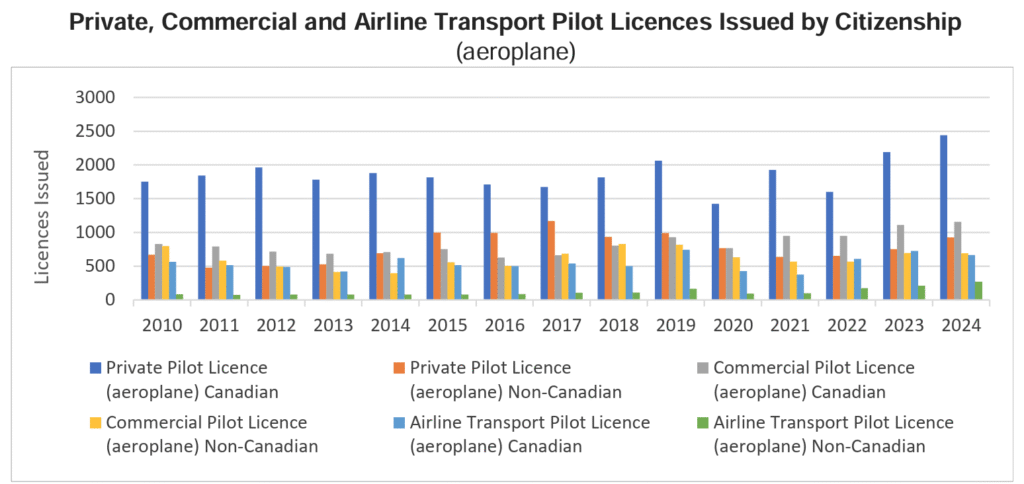
Non-Canadian pilots represent a growing portion of licence issuances, particularly at the commercial and airline transport levels.
In 2024:
- 27.5% of new aeroplane PPLs went to non-Canadians (926 out of 3,363).
- Non-Canadians made up 37% of new CPL holders and 29% of new ATPL holders.
This underscores Canada’s continued role as an international training destination, especially for students from regions where domestic training is less accessible or recognized. However, it also raises questions about how many of these graduates remain in Canada to work versus returning to their home countries.
6. Flight Test Performance: Strong Pass Rates, but Some Areas Lag
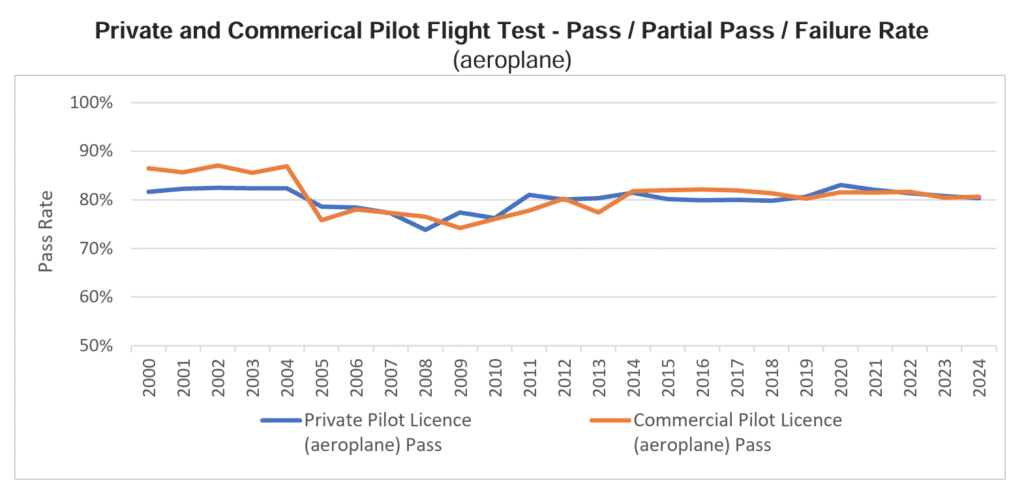
Flight test pass rates remain consistently high:
- Aeroplane PPL pass rate: ~80.3% in 2024, with failure rates around 5.5%.
- Aeroplane CPL pass rate: ~80.6%, failure rate ~5.7%.
- Helicopter PPL pass rate: exceptionally high at 97.8%.
- Helicopter CPL pass rate: 93.5%.
These figures suggest that the training pipeline is effective, but the relatively high proportion of partial passes in aeroplane categories (13–14%) may point to areas for instructional improvement, particularly in practical skills and flight test readiness.
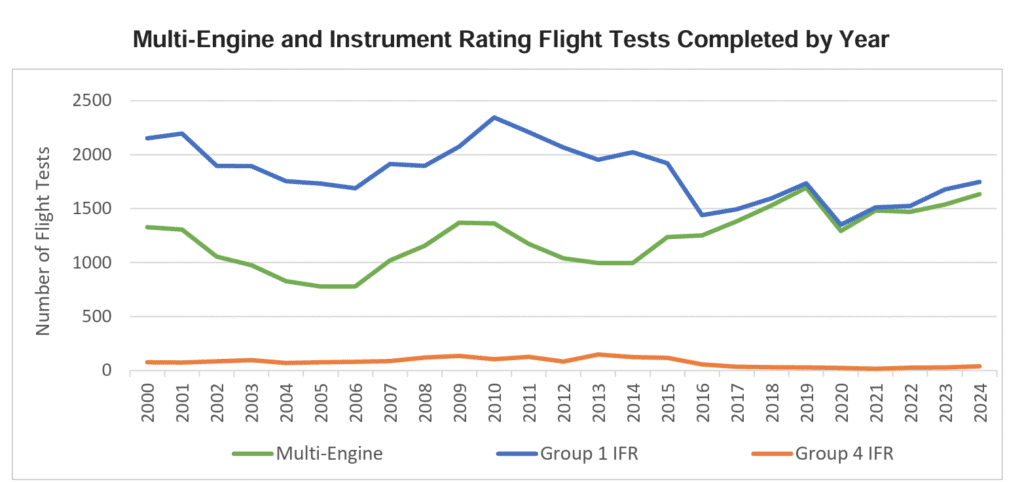
7. Multi-Engine and Instrument Ratings: Signs of Professional Growth
The pathway to advanced qualifications appears strong, with 2024 seeing:
- 1,634 Multi-Engine flight tests — the highest in recent years.
- 1,748 Group 1 Instrument Rating (IFR) tests — indicating a healthy progression of commercial pilots toward more complex flying.
The steady demand for IFR qualifications aligns with airline and corporate flight department requirements and reflects the professional ambitions of new pilots.
Post-Pandemic Recovery and Industry Implications
The data paints a clear picture: the Canadian flight training sector has largely recovered from pandemic lows, with private and commercial licence issuance returning to — and in some cases surpassing — pre-COVID levels.
Key drivers include:
- Airline hiring demand — especially at the regional level.
- Increased immigration of student pilots seeking ICAO-recognized licences.
- Improved financing options for flight training.
However, industry stakeholders must remain aware of challenges, including high training costs, instructor shortages, and the need for better diversity and retention strategies.
Opportunities for Flight Schools and Industry Stakeholders
Given these trends, there are several opportunities for the sector:
- Expand youth outreach — Early engagement programs in high schools and STEM camps can encourage the 17–19 age group to consider aviation careers.
- Enhance bridge programs — Partnerships between flight schools, colleges, and airlines can streamline the CPL-to-ATPL pathway.
- Target female recruitment — Scholarships, mentorship networks, and visible female role models can help address gender imbalance.
- Leverage Canada’s international appeal — Marketing to non-Canadian students while also creating pathways for them to work in Canada could help address pilot shortages.
Aviation Personnel Licensing Summary
With the global airline industry forecasting significant pilot shortages over the next decade, Canada is well positioned to be both a domestic talent pipeline and a global training hub. The 2024 statistics show a sector in resurgence, but also one facing structural challenges that require proactive solutions.
If the current trajectory continues — with strong youth participation, increasing diversity, and sustained international enrolment — Canada’s aviation training industry could play an even more pivotal role in shaping the future global pilot workforce.
Canadian Pilot Licensing Statistics and More from Canadian Flight Trainers: Your Partner in Aviation Success
At Canadian Flight Trainers, we’re more than just an online ground school — we’re your co-pilot on the journey from your first lesson to your dream career. Our Transport Canada–compliant courses are designed by professional airline pilots and experienced instructors, giving you the knowledge and confidence to excel in both written exams and flight tests.
Whether you’re pursuing a Private Pilot Licence, Commercial Pilot Licence, or preparing for FAA to TC conversions, we provide:
- Comprehensive online courses available 24/7.
- Exam preparation tools that target common weak points.
- Support from real-world pilots who’ve been in your seat.
- Flexible learning for students across Canada and worldwide.
Join thousands of pilots who trust Canadian Flight Trainers to help them take off toward their goals.
-
Air Canada Pilot Salary: How Much Air Canada Pilots Make in 2026
Updated September 2026 for the current Air Canada pilot contract. This article was written by a guest columnist who works at Air Canada as a Captain on a narrow body aircraft. He has made extensive contributions to our Commercial Pilot Ground School but always chooses to keep a low profile on the internet. Every number…
-
How to Calculate Cloud Bases
Aviation Weather How to Calculate Cloud Bases: The Formula Every Pilot Should Know Weather and clouds play a big role in aviation, and one of the most useful skills a pilot can learn is how to quickly calculate cloud bases. Here is the formula, where its numbers come from, and the one change Transport Canada…
-
Night Rating Requirements in Canada
The night rating is the most commonly added rating to a Private Pilot License in Canada, and for good reason. During night operations, pilots will not generally encounter rising air currents due to convection heating, making flying at night slightly smoother than daytime flying. Combine this with city lights on a clear night with the…
-
AWWS GFA
AWWS was retired on February 28, 2024. NAV CANADA’s Aviation Weather Web Site no longer exists. Everything it did now lives on CFPS — the live GFA links below are current and working. If you typed “AWWS” into a search engine and landed here, you’re probably looking for NAV CANADA’s Aviation Weather Web Site —…
-
Commercial Pilot Ground School – What Our Students Expect
Commercial Pilot Ground School Research What Students Expect From CPL Ground School: 260 Responses Analyzed Commercial students arrive with a licence, some experience, and much less patience for wasted time. We analyzed what they expect from the course, the instructors, and themselves. View CPL Ground School See the Findings 260written CPL Ground School sign-up responses…
-
Private Pilot Ground School – What Students Expect
Private Pilot Ground School Research What Students Expect From PPL Ground School: 1,000+ Responses Analyzed Before students begin our Private Pilot Ground School, we ask what they hope to achieve and what they expect from us. Their answers are a useful look at what new pilots actually need from ground school. See the Findings View…